This column will probably not make a whole lot of sense to most people, and is more personal than anything I’ve written so far, but it’s a topic I felt strongly enough about that I thought I should write something on it. I was reading this blog recently about a proposed film regarding the legend of Cuchulain, an Irish hero who really deserves to get an hour and half on the big screen and be played by Michael Fassbender (be still, my heart), and it got me thinking about culture and the ways that people use it to identify as one thing or another. In Ireland as a whole this sort of thing matters a great deal, because culture is firmly tied to religion, and that’s where it all gets a bit messy.
I was born and grew up in Northern Ireland; it’s where I live, and I have no plans to leave, because I like it here. Northern Ireland suffers from being two different cultures at once and therefore tends to fall between the two most of the time. I asked the question on Twitter about how people living here identify themselves, culturally speaking – as Irish, or British, or something in between – and was given some, to me at least, surprising answers. Some people identified themselves strongly as Irish; others said that they weren’t bothered one way or the other; some people called themselves Irish when they were abroad, as the outside world doesn’t really tend to understand the intricacies of politics here; and the majority of people who answered said they were “Northern Irish”.
The main problem that I have when trying to identify which culture I feel most affinity with is that, as I mentioned above, culture and religion have very strong links. It used to be the case that being Irish equalled being Catholic, and being British equalled being Protestant. It’s not quite the same these days, but those connections still linger.
I don’t mind saying that I was brought up Protestant, because that’s just the way it is, and it wasn’t until I went to grammar school that I was taught anything about Irish history, all of which was long enough ago that it could be viewed almost neutrally (a misnomer, to be honest, as nothing in Irish history is “neutral”). By that point, however, a tentative ceasefire was in progress between different groups of terrorists, and the recent past became a topic that my school felt it could teach to its pupils.
When I went to university, I was taught history by the man who has written the seminal history on Northern Ireland, and it was in his class that I began to realise that it was possible to admit to liking certain aspects of Irish culture that didn’t undermine my claim to be British. As I got older and immersed myself in books about Celtic myths and legends, I found more and more that I felt an affinity with Irish history and culture, and this is where my dilemma began.
On the one hand, I identify myself as British – I like that my country is part of Great Britain and the Queen is on our money. On the other hand, I feel Irish, enjoying things like traditional Irish music and Irish films and sport; I don’t have a passport, but I’ll probably get an Irish one when I do, because I’m shallow enough to admit that I like the look of it more than the British one.
I don’t know if by laying claim to both cultures means I don’t belong to either, but I have a feeling that I’ll never really resolve this problem. Calling myself “Northern Irish” seems like the best idea, combining the two in one, and solidifies on the pride that I have in living in this country, but whether it’s accepted by everyone else is a different matter altogether.
We seem to have greater difficulty with this issue here than in many other places; Scottish people, for instance, have no problems identifying themselves as such, especially after they’ve watched ‘Braveheart’. Americans are all over that patriotism thing, their pride in their history and culture obvious at even the most cursory glance. The question I’ve often wondered about most is, where does culture come from? Where does that sense of identity originate? We live in an age where immigration is a way of life, so it’s possible to live in an area where many different groups of people are clustered; many of them will have been born in a different country and have moved because of work, or because of a better standard of living. Do they identify with the culture they were born into, or the culture they’ve become part of by moving?
This topic seems particularly relevant what with the St. Patrick’s Day holiday upon us, where the world turns green and shamrocks are everywhere, swiftly followed by green Guinness, leprechaun’s and pots of gold, and much waving of the Irish national flag. I’ve never felt like I could take part in any celebrations for St. Patrick’s Day, because it’s always been presented as something fundamentally Irish and Catholic; for a Protestant to say they were celebrating the day was often regarded with suspicion.
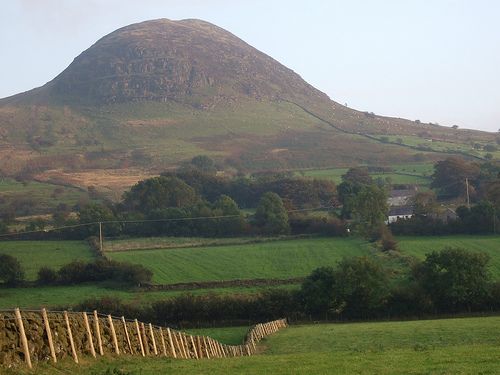
However, a few years ago, my Dad gave me a battered copy of the writings of Patrick, and I realised as I read it that here was a man who I admired. He was a man of strong faith, opinionated, often blunt, and who had a grasp of language that gave wings to his thoughts and ideas. There wasn’t a hint of snakes in sight, and it was refreshing to see. I think Patrick would be deeply embarrassed that there’s an entire bank holiday dedicated to him these days, usually as an excuse to practice Irish yoga, so it’s for that reason that I don’t take part in celebrations these days, rather than because I have a problem identifying with it as a cultural holiday. I might climb Slemish, though, (see the picture above) the mythical scene of Patrick’s confrontation with all the snakes in Ireland.
You’d think that, aged 28, I’d have figured all this out by now. I realise that I haven’t actually answered the question that I’ve posed myself in this column, but I hope I have at least made other people ask themselves about how they identify themselves culturally and as individuals within a culture; perhaps most importantly, why, and if that affects the way that we see ourselves.

Brilliant stuff, Sarah.
I’ve always thought about culture in a similar manner to human nature/psychology, where it’s often a question of what’s hereditary/inevitable from individuals and what is behavioral/learned? Tricky, deep and usually endless on thought.