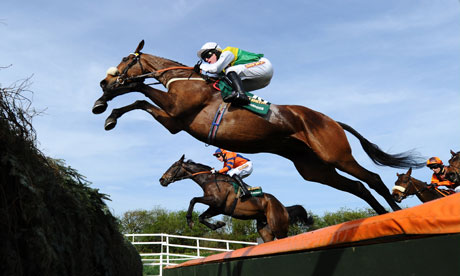
The 2012 running of the Grand National should be remembered as one of the all-time classic renewals of the world’s greatest steeplechase. The race was won by 33-1 shot Neptune Collonges by the shortest of short heads from second placed SunnyHill Boy to give trainer Paul Nicholls his first triumph in the race.
As they turned for home with two fences left to jump any horse from six were in with a shout of landing the race. Seabass was leading with Katie Walsh on board bidding to become the first lady jockey in history to win the Grand National. The oldest horse in the race, Hello Bud, had given the youngest jockey in the race, Sam Twiston-Davies, a great ride on the 80-1 shot.
As they jumped the last fence Seabass landed slightly flat-footed and the subsequent loss of momentum allowed SunnyHill Boy to take up the running. He looked strong and appeared set to give his trainer Jonjo O’Neill another victory in the race but, as any race fan knows, the run in to the line at the Grand National can be as unforgiving as any of the preceding thirty fences. As they approached the elbow SunnyHill Boy started treading water. Neptune Collonges was gaining ground on the leader. Would the finishing post come soon enough? With every stride it seemed to be getting further and further away. As they passed the post nothing could separate the two horses. This one was to be decided by the judge. After what seemed like an age it was announced the winner was Neptune Collonges by a short head. He had won by quite literally a nose. The only time he had led in the race was right at the line.
It was a classic end to a wonderful race. What a way for the BBC to bow out after covering this amazing event for so many years since it was first televised back in 1960.
However news then started to come through of the awful deaths of Synchronised and According To Pete and horse racing fans again found themselves in the uncomfortable position of having to defend the Grand National.
Synchronised had earlier ran loose before the race causing it to be delayed while he was caught and his jockey, champion A P McCoy, remounted. Synchronised unseated his jockey at Becher’s Brook first time around but continued to run around with the other horses before falling at the eleventh fence which caused his fatal injury. According To Pete was brought down at Becher’s Brook second time around which led to his death. Thoughts immediately were with the connections of both horses. No doubt Synchornised’s untimely passing brought back memories for Jonjo O’Neill of the time he rode Gold Cup winner Alverton in the Grand National. The sight of him cradling his stricken mount after his fatal fall at Becher’s Brook will stay with all who witnessed it that day. Both horses were home-bred that is to say they were pets and not the playthings of bored millionaires sent out to be killed as is alleged by some of the critics of horse racing.
Of course any death or injury that occurs in horse racing is tragic but one look at social networking sites in the immediate aftermath of the race and one could have been forgiven that there had been a wholesale massacre of the innocents given the hysterical over reaction. This isn’t to trivialise what happened but some of the emotive language that was being used was at best not helpful and at worst downright insulting.
It is cruel they opined. Well it isn’t. The RSPCA, despite calling for further changes to be made to the race have said that it isn’t cruel and that no horse is forced to race against its will. So can we put an end to that myth please? It was also stated that in the 21st century we shouldn’t be killing horses in the name of sport as if to say that we should all be above this now and anybody interested in the Grand National is some kind of Neanderthal. Again this is unhelpful. The horses are not killed in the name of sport. When a horse dies it is a tragic accident. I have seen the reaction of connections of horses when something like this happens. They are inconsolable. To suggest they are killed in the name of sport is an insult to all involved.
The Grand National will over the coming weeks face some very searching questions. There will be those taking to the social networking sites calling for the race to be banned. They cannot be allowed to succeed. The race is days supposed to be the ultimate test. It has changed almost beyond recognition over the years. Gone are the days when jumping Becher’s Brook was like jumping off the edge of a cliff and the race is much better for it. It is a fairer race and a much safer race. Vast improvements have been made to the equine safety aspect of the course. There are “escape routes” around each fence that allow horses to run around them rather than jump them. Although as was proven yesterday you cannot stop a horse from jumping a fence if it wants to. Synchronised was riderless when he made that fateful jump at the eleventh fence.
There will be a review of the race but I want it to be a sensible one. You cannot cater for every single contingency. A further reduction in the size of the fences could well lead to the race itself being reduced to just another long distance steeple chase. The jockeys are clearly riding too quickly over the fences. This speed is causing any eventual fall to be more serious. For proof of this look at the race won by Red Marauder. Only two horses did not fall that day due to the conditions but those same conditions meant that the race was run much slower than usual and, as such, there were no injuries. There has to be a change to the starting procedure. This year’s National was embarrassing with two false starts due to jockeys getting too close to the starting tape while they were actually trying to fix it. These false starts would inevitably lead to horses becoming agitated and when the off would finally be announced they would charge more recklessly at the fences. The jockeys should be forced to stand way back while they lower the tape and only walk in once the starter is good and ready for them.
There has been a call for the number of runners to be reduced. I am not in favour of that. I think a more sensible approach to the fences, less speed and more respect to be shown to them would be helpful.
The Grand National is an institution. It is one of the great sporting events in the calendar. It is in trouble now, there is no doubt about that, but let us all hope that with a sensible approach we will not be having this discussion again but instead marvelling at the brave horses and riders winning this great race in the future.
