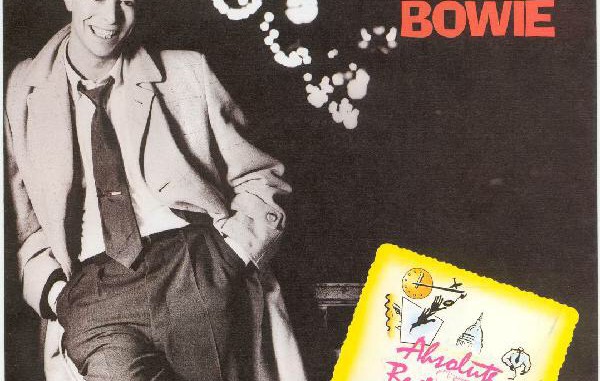
Despite what most of the retrospective rock biographies will tell you, the sun had not yet set on David Bowie in early 1986. It’s true that he had failed to consolidate the massive commercial gains he had made with the success of the Let’s Dance album and its attendant singles, and his duet with Tina Turner (his label EMI’s latest cash-cow) had not set the charts alight. However, faced with the unenviable challenge of following Queen’s astonishingly crowd-pleasing set at Live Aid, he delivered one of the most memorable performances of the day, and the much-mocked Jagger duet “Dancing In The Streets” provided the Main Man with his fifth and final Number One – the various factors that led to this could lead to its chart-topping being argued as an aberration based on circumstance, but he clearly still had some clout. In early 1985, his collaboration with Pat Metheny, ambient torch song “This Is Not America” entered the top 20 without the benefit of a promo video – quite an achievement in the image obsessed mid 1980s.
There was still some commercial cachet to be had in being David Bowie, even though he had acquired a mainstream audience that he didn’t fully relate to and was losing the goodwill of a more faithful following due to his repositioning himself as the kind of middle of the road entertainer his former manager Ken Pitt always dreamed of him becoming. He was still a bankable performer, and in 1985 to 1986 he found himself juggling various commitments which allowed him to stall EMI’s desperate pleas to make another hit record: The Live Aid gig, an invitation to star in Muppet maestro Jim Henson’s latest fantasia, and some soundtrack themes, one of which would be coupled with an acting job for Julien Temple, the enfant terrible responsible for the incendiary “The Great Rock N Roll Swindle”.
Since 1982, when Bowie collaborated with Giorgio Moroder for the theme song to Paul Schrader’s sensual remake of film noir horror Cat People, he would find a diverting sideline in crafting one-off Bowie classics for big budget movies, such as the aforementioned This Is Not America, for the Sean Penn conspiracy drama The Falcon And The Snowman.
The singular success of David Bowie’s 1984 album Tonight was the twenty-two minute short film Jazzin’ For Blue Jean, conceived to support Bowie’s Blue Jean single. It afforded Bowie the opportunity to display his comic chops and also send himself up, playing the twin roles of window cleaning wide-boy Vic and narcissistic rock star Screamin’ Lord Byron.
In Temple, Bowie had found a kindred spirit, and having sung the praises of Ridley Scott’s younger brother Tony while making The Hunger, found another scion, whom he declared in no uncertain terms as the saviour of the then-ailing British film industry.
Thus, Bowie was soon drafted in by Temple to play a significant role in Temple’s first major movie, an all-singing, all-dancing big screen adaption of Absolute Beginners, Colin MacInnes’ classic British novel about a young man trying to make it big in Soho in the 1950s, as post-war Britain began to trade off austerity for prosperity in the wake of the beat boom, with the racially inflamed Notting Hill riots casting a broad shadow over the hedonism of the youth explosion.
Temple tentatively courted Bowie to play a starring role in the film, and Bowie leaped at the chance to play the slick advertising executive Vendice Partners. The appeal was obvious –Bowie himself had encountered many such characters, all Italian suits, smooth patter and transatlantic twang during his years as a junior designer, mod waif and struggling musician in ‘60s Soho. The character’s name was a corruption of Vance Packard, the author of The Hidden Persuaders, the book which opened the lid on media manipulation and the seduction of advertising, and it’s worth noting that not only would Bowie would list The Hidden Persuaders amongst his 100 favourite books in a 2003 poll, and that Packard’s study influenced much of his formative thinking on image and presentation.
“David was hugely into this, the simultaneous birth of the teenager, and the creation of a market”, Temple enthused. “And like everything he does, there was total commitment.”
Work on the film began in early 1985. Early on in the genesis of the film, Bowie was required to perform a musical number in which Partners seduces Colin with all the temptations of fame and glamour that owed more than a little bit to the dazzlingly ambitious displays of Busby Berkeley and Arthur Freed in the golden age Hollywood musicals, arranged by the legendary Gil Evans, Miles Davis’ collaborator during his ‘symphonic jazz’ period. The number was called “That’s Motivation” and Bowie embellished it with every ad-man cliché he could think of (“As fresh as tomorrow!”) and ultimately delivered a performance that would have warmed his former manager Ken Pitt’s heart – Bowie as light entertainer, his Anthony Newley fantasies made flesh.
The twanging motif that introduced “That’s Motivation” provided the trigger for Bowie’s second, and more memorable, contribution to Absolute Beginners. Temple recalls, “He’d written That’s Motivation, which we needed. And he surprised me with Absolute Beginners. He was surprised by it as well – it just kind of arrived.”
David Bowie was about to craft his last top five hit of his career, and it would not be in support of an album or a major tour – much to his label EMI-USA’s frustration, distraught at seeing Tonight and its attendant singles failing to replicate the Let’s Dance effect – but for a domestic film project whose prospects were by no means a given, despite the amount of goodwill and pre-publicity Absolute Beginners was achieving via word of mouth in trendspotting journals such as iD and The Face.
Bowie called up Hugh Stanley Clarke, A&R at his label EMI, for musicians. For the recording session, he opted not to use his recent collaborators, instead working with producers Clive Langer and Alan Winstanley, whose previous credits included Teardrop Explodes, Dexy’s Midnight Runners and most notably Madness, responsible for the lion’s share of the Nutty Boys’ infectious hits that dominated the early 1980s. A top-line band of session musicians was assembled, whose number included synth whizz Thomas Dolby, Elvis Costello sideman Steve Neive, and – joining Bowie for the first time since Hunky Dory – virtuoso keyboardist Rick Wakeman. Also joining the ranks was Kevin Armstrong, who would work with Bowie intermittently for the next decade.
In summer 1985, these crack session musicians converged at Abbey Road Studios, under the shadowy directive that they would be working for ‘Mister X’ – with an EMI associate giving the only clue to their employer’s identity: “He has a glass eye.”
Bowie biographer Paul Trynka notes that Absolute Beginners came together “almost instantaneously”. Like all of Bowie’s greatest triumphs from The Man Who Sold The World through to Reality, the song was developed in the studio in a loosely collective fashion. “David came in with the song half written”, Kevin Armstrong remembers. “The whole band helped out, whether it was a missing chord or a rhyme for the last verse. Over an afternoon it evolved into the backing track, which we recorded. That’s how Bowie operated – from the germ of an idea, which the group polished up into the master. Once he saw what we could do, he relaxed. We fitted.” Bassist Matthew Seligman was similarly praiseworthy: “David liked to work at top speed. He said he loved the Abbey Road session, which reminded him of ‘Heroes’”.
Essentially, this has been Bowie’s working method for the vast majority of his career. A solid rhythm backing, against which he was free to experiment with melodies and groove, with the lyrics and vocal arriving late in the day.
It’s not hard to see why the song came together so quickly: The repeated “bap-bap-ba-ooh” refrain was a doo-wop cousin of “Let’s Dance”’s “Twist and Shout” influenced intro, and utterly appropriate for the film’s jazz and R&B setting. For the verses and chorus Bowie had concocted a tender ballad not a million miles away from Station To Station’s side-closers “Word on a Wing” and “Wild Is The Wind”, a husky, delicate, baritone, half-mumbled but utterly clear in its diction, soaring into an epiphany of a chorus, and the platitudes were of the honest, direct and simple protestations of love that Bowie had become more comfortable with since exorcising his masks with “Low” in 1977. It was almost as if he could walk into his kitchen, pluck a few tins of ready-made Bowie ingredients from the cupboard and concoct an instant classic over a low hob. This, in fact, would be a process that would serve him well from Black Tie White Noise right up to 2013’s The Next Day album – treating the aggregated works of his back catalogue as a palette, to draw from at will in different permutations.
Lyrically, listening again to Absolute Beginners, one notes that in some respects it’s a rewrite of “Heroes” – its narrator starts from a point of desperate hopelessness, one half of two lovers stuck in a hopeless transaction (“I’ve nothing much to offer, there’s nothing much to take”), before seizing on a note of defiant optimism (“as long as we’re together/the rest can go to hell”) and riding it out into the chorus in a spirit of romantic escapism (“If our love song/could fly over mountains”). As a successful rewrite of Bowie’s most enduring, ‘in the gutter looking at the stars’ ballad, how could it fail?
The only note of controversy during these sessions was flagged up by rookie recruit Armstrong, in an incident that provides a footnote to the dissolute antics of his 70s incarnation and the cold war that existed with his ex wife: “The only time I was ever with David Bowie that I saw him do anything with drugs was at that very first day.” Armstrong told biographer Trynka. “I don’t know why he picked me, but he asked me to get him some coke halfway through the day. I rang a friend to see if he had any going – he rang me back an hour later to say he’d managed to find someone who’d helped him out: ‘You will never guess who I’ve got this coke from? Angie Bowie!’ and I said, You’ll never guess who it’s for – David Bowie!’”
Bowie laid down his vocals at a later session, in a session on August 18 1985, at Westhouse Studios, Shepherds Bush which would prove to be one of his finest vocal performances of his entire career. Moody when needed during the verses, soaring and transcendent during the chorus, somewhere in the hot zone between Elvis boom and Sinatra croon, and supported by a female vocalist who sounded uncannily like Kate Bush at her most gossamer-like and winsome.
Amusingly, while laying down his vocals, the Dame indulged in some japes, performing verses in the style of Johnny Cash, Iggy Pop, Bruce Springsteen, Neil Young, Tom Waits and others, giggling, “I’m just fucking about now!” To fans’ delight, this tape leaked out on YouTube not long after his death. Worth a listen.
Meanwhile, back at the ranch, “Absolute Beginners” was mixed, mastered and cut down to three discrete edits – a full-length version of 8.01 minutes with reprises and some urgent and impassioned saxophone and percussion breaks adding to the drama, a single mix of 5.35, and a promo mix of 4.46. The single was released on Virgin on March 3, and accompanied by a lush promo video with Bowie at his most stylish, in long coat, trilby, and natty tie, wandering along the Embankment area of London, filmed in monochrome, and intercut with footage from the movie. It drew inspiration from the 1959 ‘lonely man’ Strand cigarette advert directed by Carol Reed, while also recalling the cinematic touchstone of doomed romance Brief Encounter in its café scene. A pitch perfect pastiche that, when aired in cinemas, doubled as a trailer for the Absolute Beginners movie due to premiere the following month.
The movie “Absolute Beginners” opened as the title song began slipping back down the charts, and due to the egregious amount of advance publicity it had received, Fleet Street’s knives were sharpened. Many of these wounds were self-inflicted, in a sense, as Temple and co. talked up the film before the rushes were in: “The greybeards who ran cinema were not willing to listen to us young people. The answer was basically: “Fuck off.” Mike Leigh and Ken Loach were the cutting edge of cinema at the time – a musical, with all its’ spectacle, went against the grain. So we talked up the idea in the Face and NME, just to say: “Look, people are interested in this.” That was probably a mistake, because it created this hype that snowballed out of control – Julie Burchill reviewed the film before it had even been made.”
The film has not been judged kindly, but a lot of that is due to our old friend ‘received opinion’. A typical late period Bowie biography hand-waved the film as “a grating amalgam of pop video and musical… neither the turkey some critics have dubbed it nor the critical and commercial success [producers] Goldcrest desperately needed”, before concluding, “In the end, Absolute Beginners was more a commentary on a kind of ‘80s vacuity than on the 1950s’ spirit of adventure and now-ness.”
Pop culture historian and commentator Tim Worthington, summarised the film as “a grand overhyped overlong jumble of a stylistically inconsistent bewilderingly directed Patsy-Kensit-meets-Courtney-Pine-meets-Sade-meets-Smiley-Culture-meets-Lionel-Blair mess, which may be many things but is never, ever boring. On any level”, before going on to say, “it’s never been given a fair critical crack of the whip and is a lot better than you’ve probably been told it is, and in any case, the bizarre story of how it came to be made in the first place, and then bomb so dramatically, is nothing short of a goldmine if you’re interested in the relationship between society, culture and popular culture.” Which is enough to make you want to watch it again, isn’t it?
“Absolute Beginners” gave David Bowie his biggest hit single in three years, rapidly climbing to Number Two in the UK, held off from the top spot by Diana Ross’ Bee Gees-penned Motown revival “Chain Reaction”; itself usurped by Cliff Richard and BBC’s The Young Ones’ charidee record “Livin’ Doll”. From the sublime to the ridiculous, but that’s pop music, kids.
The success of “Absolute Beginners” was something of an irritant to Bowie’s label, EMI-USA. The Let’s Dance heyday seemed long gone, and Bowie’s last number one – recorded back to back with Absolute Beginners the previous summer – was Dancing In The Street, the Live Aid jamboree with alleged bed-hopping pal Mick Jagger and recorded with similar personnel to the Beginners session. (When the Absolute Beginners session folded, Bowie told his musicians, “I’ve got this gig…”)
Furthermore, his next two singles would also be in support of movies – “Underground” from Labyrinth, and “When the Wind Blows” for the animated, nuclear war morality play of the same name. Neither would trouble the charts the way “Absolute Beginners” did, but they were enough to worry his label that another hit album was overdue and wasn’t it time he stopped mucking about? But that’s another sorry story.
The song “Absolute Beginners” would rise from the ashes of Temple’s glorious folly, providing a rare moment of quality on the Glass Spider Tour, where it remained part of the set list as it trudged from Rotterdam to Sydney; cruelly omitted from the Sound + Vision “greatest hits” tour of 1990; then receiving a second bout of favour when revived by Bowie, in his full ‘elder statesman of rock’ pomp in 2000, as a centrepiece of a televised concert at the BBC Paris Cinema Studios, with Bowie embracing the song as if reunited with a long lost love, complete with the “That’s Motivation” inspired prelude. A few days later, it would receive its ultimate benediction as part of a triumphant headline set at Glastonbury Festival the same summer, by common consent one of Bowie’s finest later period performances.
Puzzlingly, the song was omitted from 1990’s supposed hit collection “Changesbowie”, which chose to end the story with the then six year old “Blue Jean”, but the deficit has since been rectified, with the lengthy single edit sitting pretty on the numerous Bowie hits albums since. The song is clearly well loved, as on the day of David Bowie’s death, it was number 20 in that day’s chart of Bowie downloads on iTunes.
That it fell one chart position short of the number one spot is why it’s this writer’s belief that it’s “Absolute Beginners”, not “Let’s Dance”, that marks the end of David Bowie’s imperial period, a reign in which he was a recognisable cultural figure, still able to make his presence felt even while his detractors had their barbs aimed in the sidelines. He would scrape the upper reaches of the charts intermittently – “Jump They Say” (1993) and “Hallo Spaceboy” (1996) – seen by all but the faithful as comebacks, but he would never scale such chart heights so gracefully again.
Author bio: James Gent has contributed to several acclaimed publications devoted to cult and popular television including 1001 TV Series You Must Watch Before You Die, You & Who: Contact Has Been Made and Blake’s Heaven: Maximum Fan Power. In 2014, he wrote the biography for the official Monty Python website.