If there is one word that best characterizes Romania, eclectic would be the best choice. Described by many as a country of contrasts, Romania has a little bit of everything. Breathtaking landscapes, friendly people, historical sites and delicious organic food are just a few of the reasons that will convince you to visit this lesser-known Eastern European country.
One of the hardest things to do when visiting Romania is deciding which of its regions and attractions to explore first. That’s why we put together this list with five suggestions for places to visit to make your planning easier!
Vibrant Cluj-Napoca
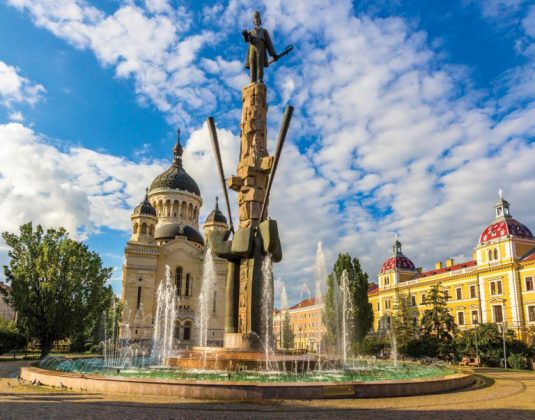
Cluj-Napoca is the unofficial capital of the famous region of Transylvania and a very good base to start your visit in Romania. The city’s airport is well serviced by Wizz Air with many flights from all over Europe. Cluj-Napoca is amongst the most lively and richest in culture cities in Romania. One of the oldest cities in the country, with documents attesting its existence prior to the Roman colonization, the cultural life of Cluj-Napoca attracts thousands of young people who move here from all regions of the country to study or work.
The Main Square, surrounded by 18th and 19th-century buildings is home to the Gothic St. Michael’s Church, the church with the tallest tower in all of Romania. Apart from museums, parks, and an astonishing Botanical Garden, which holds both a Japanese and a Roman garden, the city’s lifestyle will be the thing that makes you want to stay here just a little bit more.
Cluj is also a great base to explore the rest of Transylvania with many popular attractions nearby. Book day trips from Cluj-Napoca to see famous sights such as Turda Salt Mine, Sighisoara Citadel or Corvin Castle, or to go hiking in Apuseni Mountains. With the help of tour guides you’ll also discover the best places to eat traditional food, understand Romanian history and culture.
Turda Salt Mine

If you decide to visit Cluj Napoca, then you should visit Turda Salt Mine. The mine itself dates back to the Roman empire, but it isn’t its historical importance that attracts so many visitors. A few years ago the mine was transformed into an impressive amusement park with beautiful decorative lights that highlight the beauty of Earth’s underground at 120m!
Looking just like it landed from a Star Wars movie, the park hosts a Ferris wheel, famous all over the country, as well as a bowling alley and a golf course, to have a bit of fun with friends. On top of that, there’s an underground lake that can be explored by renting a boat and paddling around, to see the mine from a different perspective. Finally, you can also visit the mining museum set up in the mine with all sorts of machines and equipment used to dig the mine and extract salt.
Sighisoara Citadel
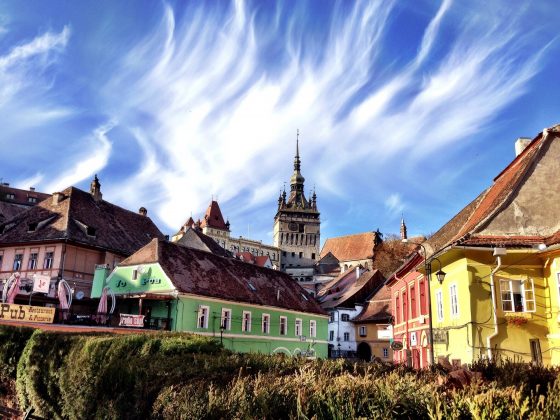
Looking for a picture-perfect place to spend your vacation? What could be more perfect than Europe’s best-preserved medieval citadel? If you are a history savvy, or simply want to let yourself be amazed by the architectural feeling from medieval times, Sighisoara Citadel is the place you should visit.
Medieval townhouses with Gothic churches and impressive defense towers will make a visit to this medieval city feel like traveling back in time. Want to enjoy the best of Sighisoara? Come visit during the annual Medieval Festival held during the last weekend of July. You will be entertained with medieval dances, duels and fair ladies and knights roaming the streets in the search for their soulmates. Artisans will present their wares
The Danube Delta – nature’s miracle garden
The Danube, once the Roman Empire’s long-standing natural border, flows through 10 European counties before spilling into the Black Sea through Romania’s South-East region of Tulcea. Here it forms one of the largest and best-preserved deltas in Europe listed as a UNESCO site. The Danube Delta spreads for 5,165 square kilometers but an interesting fact is that its area is growing by around 40 square meters yearly thanks to the sediment brought by the Danube . This has to do with the fact that the delta is one of Europe’s newest pieces of land, meaning it will take a while before we get to see the Danube Delta’s final form.
Trying to put into words the peculiar and unique setting of the region is hard. At a quick glimpse, it seems to be the place where nature decided to define its own laws, starting with ancient small islands with subtropical vegetation, unusual for this region of the world, and continuing with a variety of swamps, lakes, forests, and dams. The spectacular flora is home to an even more spectacular fauna, with over 300 bird species and over 3,400 animal species, both terrestrial and aquatic.
Tourism in the area is mostly organized by locals who provide accommodation, transportation, and guides to visitors. After all, who better people to show you the area, than those who live there themselves? Speaking of locals, they recommend that, if you want to enjoy the Delta at its finest, you should plan a trip anytime between April and September.
The ruins of Sarmizegetusa Regia

Compared by many with England’s Stonehenge, Sarmizegetusa Regia was once Dacia’s capital, the place where all military and political decisions took place. Located in the Orastie Mountains, the archeological site looks nothing like you’ve ever seen before. The discoveries on-site prove the fact that the Dacians had a quite high standard of living, with ceramic pipes directing water to the nobility’s houses, a sundial and a sacred zone that is still a mystery to most.
A trip to Sarmizegetusa Regia can serve as a complex history lesson and a rare chance to see what life was like before the Roman Empire conquered the Dacians. In total there have been seven temples discovered, along with an unusual altar of sacrifice, raising many questions about the Dacian’s spiritual and religious life.
Although one of the strongest civilizations during their time, the Dacians didn’t leave much behind, besides some mythical tales about brave men with blue eyes and red or blonde hair. This is why many of the discoveries, such as the largest sanctuary discovered at Sarmizegetusa, still remain a mystery.