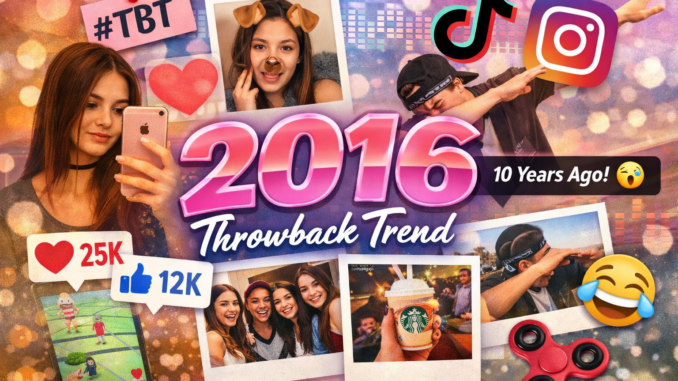
If you’ve been scrolling Instagram or TikTok recently and wondered why your feed suddenly looks like a time capsule from the mid-2010s, you’re not alone. From grainy selfies to Snapchat dog-filter screenshots, social media is currently awash with throwback photos labelled simply: 2016.
So where did this trend come from — and why has it struck such a nerve?
The rise of the 2016 throwback trend
The trend began gaining traction at the start of 2026, when users collectively realised that 2016 was officially ten years ago. That realisation alone was enough to spark a wave of nostalgia, but once a handful of posts began circulating on TikTok and Instagram, the format quickly snowballed.
There’s no single creator credited with starting it. Instead, it’s one of those trends that feels like it emerged everywhere at once: one person posts a 2016 photo, another follows, and soon it becomes a shared internet moment.
Some captions are playful (“I really thought this was a look”), others are sentimental, and many are simply left unexplained — letting the image speak for itself.
Why 2016, specifically?
For many millennials and older Gen Z users, 2016 represents a formative era of internet culture. It was a time when social media felt less curated and more experimental.
Think:
• Early Instagram aesthetics before heavy filters and brand deals
• Snapchat streaks and face filters
• Viral memes that felt chaotic rather than strategic
• Less pressure to “optimise” content for algorithms
Posting a 2016 photo isn’t just about how someone looked — it’s about revisiting a version of the internet that felt more carefree.
The nostalgia factor
Nostalgia is one of the most powerful forces on social media, and the ten-year mark hits particularly hard. A decade is long enough for styles, technology and online behaviour to change dramatically, but close enough that the memories still feel personal.
For many people, a 2016 photo captures:
• Their teenage or early-adult years
• A time before major life responsibilities
• A less performative relationship with social platforms
In a digital landscape that now feels crowded, monetised and constantly evolving, looking back can feel comforting.
Why the trend resonates right now
Beyond the anniversary, this trend taps into a broader mood online. There’s been a growing sense of fatigue with hyper-polished content and relentless trend cycles. Sharing an old photo — often unedited, awkward or blurry — feels refreshingly human.
It’s also an easy trend to join. No editing skills required, no shopping links, no perfect lighting. Just scroll back in your camera roll and post.
A collective internet memory
Ultimately, the 2016 throwback trend is less about individual transformation and more about shared experience. It’s a reminder that while platforms change, trends fade and algorithms evolve, we’re all moving through the same digital timeline together.
And if nothing else, it’s proof that one thing never goes out of style on the internet: looking back and saying, “Wow… that was ten years ago?”