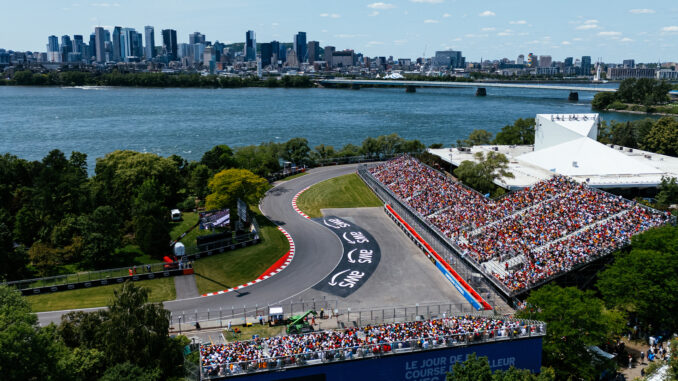
With the Formula 1 Canadian Grand Prix just around the corner, we thought it was the perfect time to dig into everything that makes this legendary circuit so special. From its extraordinary origins on a man-made island to the infamous wall that has humbled world champions, here are 40 facts about the Circuit Gilles Villeneuve you might not know.
Origins & Planning
- The island on which the circuit sits was created using millions of tonnes of rock excavated during the construction of Montreal’s Metro system — construction began in August 1963 and the island was essentially complete by mid-1964.
- The island was originally built to host Expo 67, the World’s Fair held in Montreal in 1967, where it served as a key venue for showcasing innovations and cultural displays from around the globe.
- After Expo 67, Île Notre-Dame was also the venue for the rowing and canoeing events at the 1976 Montreal Summer Olympics — before anyone had thought to put a racing circuit on it.
- The Canadian Grand Prix had previously alternated between Mosport Park near Toronto and Circuit Mont-Tremblant in Quebec, but safety concerns — particularly after issues at the 1977 Mosport event — prompted the move to a new venue in Montreal.
- The circuit was designed by Roger Peart, the president of the Canadian Automobile Sport Clubs — and because it largely made use of the island’s existing road network, construction didn’t take long at all, with the circuit ready to host its first F1 race in the same year building began: 1978.
- A huge crowd attended that first race in 1978, including Prime Minister Pierre Trudeau — a sign of just how significant the event was for Canada from day one.
- The circuit is located within Parc Jean-Drapeau, named after the Mayor of Montreal who was responsible for organising Expo 67 — so the park, the island, and the circuit are all linked to the same man’s vision for the city.
- The track was absent from the F1 calendar only twice between its debut in 1978 and 2019: in 1987 due to a disagreement with Bernie Ecclestone’s Formula One Constructors’ Association over sponsorship, and in 2009 when contractual issues saw the event lose its place to Abu Dhabi.
Naming & Gilles Villeneuve
- The circuit was originally called the Île Notre-Dame Circuit — and was renamed in 1982 in honour of Canadian Formula One driver Gilles Villeneuve following his death earlier that year.
- Gilles Villeneuve won the inaugural race at the circuit in 1978, driving for Scuderia Ferrari — making it his first ever Formula One victory, at what would eventually become the track bearing his name.
- Gilles Villeneuve was born in 1950 and died in 1982 — he was killed during qualifying for the Belgian Grand Prix, just weeks before the Canadian Grand Prix that year.
- Gilles Villeneuve’s son Jacques became Canada’s only Formula One World Champion in 1997 — but despite racing on the circuit named after his father multiple times, he never won there. His best result was second place on his home debut in 1996.
- The circuit’s layout is widely considered to reflect Gilles Villeneuve’s driving style: aggressive, technical, and unforgiving of mistakes.
- The tragic 1982 Canadian Grand Prix — the first race held at the newly renamed circuit — is remembered for the death of Italian driver Riccardo Paletti at the start, just weeks after Gilles Villeneuve himself had perished. It was the last death during an F1 race until Ayrton Senna at Imola in 1994.
Track Facts & Specifications
- The Circuit Gilles Villeneuve measures 4.361 km (2.710 miles) in length — making it one of the shorter permanent circuits on the F1 calendar.
- The circuit has 13 turns and is owned by the City of Montreal. It holds an FIA Grade 1 licence — the highest classification awarded to racing circuits.
- Drivers complete 70 laps of the circuit in the Grand Prix, covering a total race distance of 305.27 kilometres.
- The circuit is classified as a low-downforce track — fast and stop-start, with lots of heavy-braking chicanes and the famous hairpin testing the brakes hard, but with quick, flowing sections in between.
- The circuit is consistently voted one of the drivers’ favourites on the entire F1 calendar — a rare combination of challenge, spectacle, and atmosphere.
- The fastest ever lap around the circuit was set by Sebastian Vettel with a time of 1:10.240 during qualifying for the 2019 Canadian Grand Prix — though as it was set in qualifying, it is not recognised as the official race lap record.
- The circuit’s layout has remained largely unchanged over the decades, with only minor modifications. In 2002, the pitlane exit was moved to prevent cars from rejoining at high speed into Turn 1, and the Turn 10 hairpin was moved back to shorten the circuit slightly and allow for more run-off area.
- In 2017, following the higher cornering speeds of the new technical regulations, additional Tecpro barriers were installed around the circuit after older tyre barriers were removed — a significant safety upgrade ahead of a year when lap times were expected to fall by three to five seconds.
The Wall of Champions
- The Wall of Champions earned its nickname in 1999 after three Formula One World Champions — Damon Hill, Michael Schumacher, and Jacques Villeneuve — all crashed into the same barrier at the final chicane during the Canadian Grand Prix.
- The first driver to hit the wall in that infamous 1999 race was actually Ricardo Zonta — who, while not an F1 World Champion, was the reigning FIA GT Champion and International Formula 3000 title winner.
- Michael Schumacher hit the wall on lap 29 of that race after misjudging the corner, dislodging both right-hand tyres from his Ferrari — and was notably icy when asked what happened on his walk back to the pits.
- The race set a record at the time for having the Safety Car deployed four times, which had never happened before in Formula One at that point.
- The irony of the wall’s name is sharpened by the advertising slogan that adorned it for many years: “Bienvenue au Québec” — Welcome to Quebec — which offered a rather unwelcoming greeting to the champions who ended their races there.
- Other famous victims of the Wall of Champions over the years include Alex Wurz (1997), Juan Pablo Montoya (2006), Jenson Button (2005), Sebastian Vettel (free practice, 2011), and Kevin Magnussen (2019).
- In Formula 1 races, any car that makes contact with the Wall of Champions now automatically brings out a Safety Car or Virtual Safety Car.
- The wall also carries a French nickname — “Mur du Québec” — used alongside the more famous English “Wall of Champions” moniker.
Race History & Records
- Michael Schumacher and Lewis Hamilton share the record for the most wins at Circuit Gilles Villeneuve — both have won there seven times. Schumacher’s victories came between 1994 and 2004; Hamilton equalled his tally with victory in 2019.
- The 2001 Canadian Grand Prix was unique in F1 history: it was the first time two brothers finished first and second in a Formula One race, with Ralf Schumacher winning ahead of Michael.
- Robert Kubica’s victory at the 2008 Canadian Grand Prix was the first — and so far only — Formula One win by a Polish driver.
- Despite German drivers amassing 24 podium finishes at Circuit Gilles Villeneuve, Sebastian Vettel’s third-place finish in 2014 is the only occasion a German driver has stood on the final step of the podium there.
- Max Verstappen won the Canadian Grand Prix in 2022, 2023 and 2024 — three consecutive victories at the circuit.
- The circuit is one of very few in the world to have hosted Formula One, Champ Car, NASCAR, and Grand Am Sports Cars all on the same layout — providing a rare opportunity to directly compare lap times across disciplines.
- In 2007, Kevin Harvick won the first NASCAR Busch Series race at the circuit — one of the most controversial NASCAR races ever run, after Robby Gordon claimed to have won before being disqualified.
- Because the circuit has hosted NASCAR events, the pit lane was expanded significantly — it now must accommodate a minimum of 43 cars, far more than F1 would ever require.
Attendance, Contract & Future
- The Canadian Grand Prix attracts around 330,000 fans across the three-day race weekend, transforming Montreal into a city-wide motorsport party. In 2024, a record 350,000 fans attended, with 2025 breaking that again with 352,000 over the weekend.
- Just days after that record 2025 attendance, Formula 1 announced a new four-year contract extension with Canadian Grand Prix organisers — confirming Montreal’s place on the F1 calendar until at least 2035.
Whether you’re heading to Montreal or watching from home, the Canadian Grand Prix is one of the most unpredictable and entertaining weekends of the entire Formula One season — and with a wall that even world champions can’t resist, there’s always drama waiting to happen.