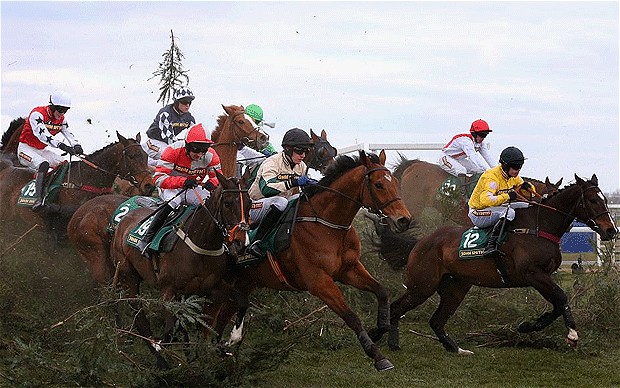
Following the last renewal of the world’s greatest steeplechase I took to this site to defend it against its many detractors. The two fatalities, Synchronised and According To Pete, had put the race in mortal danger as its many detractors queued up to lambast it as nothing more than blood sport, a brutal spectacle masquerading as sport. Aintree and British horseracing had to something and quickly.
To their great credit the British Horseracing Authority together with Aintree officials, people within the sport such as jockeys, trainers and owners got together with the RSPCA to save the race. They noted the many factors that was causing problems within the race, the speed that the horses were taking the fences, the number of fallers, the design of the fences and the increasingly chaotic starts and did something about all of them.
The start was moved ninety yards nearer to the first fence away from the grandstands to protect the horses from the roar of the crowd and making them less nervous. The added effect of this was that the speed that the horses would be reduced at the approach to the first fence and thereby lessen the number of fallers. The design of the fences was also altered considerably with the biggest amendment since slopes were introduced on the take off side of the fences as the wooden birch stakes were taken out of the base of each fence and instead replaced with plastic fake spruce with real spruce added on top. The idea was to produce a much more forgiving set of fences, not necessarily easier for the horses to jump but designed to make any fall less dangerous particularly for tired horses on the second circuit.
The new fences were given a trial run during the winter Becher Chase and given a unanimous thumbs up by the jockeys who rode so Aintree decided to roll out them over the much bigger fields in the Grand National meeting itself.
The first race over the new fences at the National meeting was on the Thursday with the amateur jockeys riding in the Foxhunters Chase. My initial thoughts was that there seemed to be much more give in the fences but they were still a test as horses still fell at various points throughout the race. However all the fallen horses got up okay and without injury. The one fatality was Battleship ridden by Katie Walsh who died of a heart attack in the race. This sad death could have happened anywhere at any time but because it was at Aintree the race’s detractors jumped upon it with shameless glee. Animal Aid laughably calling the race chaotic from start to finish.
The second race of the meeting to go over the big fences was the Topham Chase on Friday. Again the fences appeared much more forgiving with still many horses in contention as they approached the closing stages. It was as they jumped the fourth fence from home that the majority of horses fell, including Little Josh. Unfortunately Little Josh fractured a shoulder and had to be put down. Once again the naysayers, including people who do not watch racing until the Grand National comes around queued up to batter Aintree. They ignored the fact that even the RSPCA said it was too soon to blame the fences as they noted that Little Josh had not actually jumped the fence but had fallen through it, therefore, it was far too early to suggest that the new fences were in any way to blame for the poor horse’s untimely death.
All this though, and I will freely admit it, left horseracing holding its collective breath for a cleanly run Grand National on Saturday. Many experts were almost pleading for Katie Walsh to become the first lady jockey to win the Grand National and improve upon the previous year’s third pace on Seabass as the race needed “a story” behind the winner for which it had become famous. All I wanted was for all forty horses to come back home in one piece. I do not believe that the world’s greatest steeplechase and the race that sparked my love affair with horse racing could survive any further terrible news about one of the horses.
At 4:15pm on Saturday 6th April the horses lined up at the start of the 2013 Grand National. Thankfully, the starter was sensible and did not hang about insisting on an immaculate line, the jockeys did not try to rush the tape as in previous years and the horses got off to a nice, clean start. Excellent. That was the first problem overcome. The next issue was the speed of the horses during the usual charge to the first fence. Now, maybe somebody can confirm this but to my eye they seemed to be travelling just that little bit slower than usual. The forty horses were still galloping but it did not appear to be as out of control as in previous Nationals. They jumped the first fence, the give in the fence together with the levelled off landing side meant that there were no fallers. All forty were still standing. That is some achievement as the first fence usually brings down an inordinate number of fallers for what should be, by Grand National standards, a straightforward obstacle. However, that was the first fence and there are thirty such fences in the Grand National including some fearsome ditches, not to mention Becher’s Brook and The Chair. Remarkably though the pattern of the first fence continued with no fallers at all over the opening seven fences. A huge roar from the crowd greeted the news that all horses had cleared Becher’s Brook and for the first time in the race’s long history the entire field was still intact as they jumped the eight fence, the Canal Turn. There have been occasions when there have been more than forty still in the race at this point but that was back in the days of a crazy number of horses running before the safety limit of forty was introduced. Never before had there been no fallers at all at this point. The Canal Turn claimed the first departees as three horses unseated their jockeys at the Canal Turn. See? These fences still have some teeth.
The vast majority of runners were still in contention as they embarked on a second circuit and another cheer arose from the 70,000 strong crowd as the on course commentator declared that thirty-three horses were still running. The second circuit showed much clearer why there were so many horses still running as the jumping became more tired. The horses, unable to jump OVER the fences, were actually jumping THROUGH them. A year ago a lot of these horses would have fallen but not in the 2013 National.
With so many horses still in contention it was anybody’s race, the well fancied Tea For Three and Seabass well placed and running well. Seabass faded with, perhaps, the extra weight following last year’s efforts taking its toll although his trainer, Ted Walsh also laid some of the blame at what he called the “dead ground” for the way Seabass finished. Tea For Three remained well in contention though until the final fence when, joined by Cappa Bleu and Auroras Encore, he seemed to hit the fence badly. Tea For Three did not fall (I suspect last year with the more unforgiving fences he would have) but it was still enough to knock him out of his stride. Auroras Encore and Cappa Bleu strode on towards the elbow. The Grand National has the longest run in from the final fence to the finishing post in racing. So many horses have seen their winning positions overturned at this point. Crisp in 1973 and Garrison Savannah in 1991 are the two unlucky horses that immediately spring to mind (I backed Garrison Savannah that year and can still remember jumping around the house at 14 years of age believing I had picked the winner). Auroras Encore was not to be denied and won at astonishing odds at 66-1. The only people happier than the jockey Ryan Mania and trainer Sue Smith were the bookmakers who confirmed this was a better result for them than when Mon Mome won at 100-1 as they confirmed even less people had backed the 2013 hero.
At the end of the race it was confirmed only two horses actually fell throughout the race, as compared to ten in 2012 and 2011 and thirteen in 2010. The other horses that failed to complete had either unseated their jockey or had been pulled up. Most importantly, all horses and jockeys returned home safe and without injury. This precisely the effect that Aintree officials had wanted. They desperately needed a Grand National that was safe whilst still retaining a sense of being a spectacle. I believe, despite the lack of fallers, it still remained a unique challenge. Some people may protest that the fences were too easy but, as somebody pointed out to me on Twitter after the race, who actually wants to see a horse fall? The Grand National should be a unique challenge, the ultimate test of horse and jockey but, if the race is to remain a fixture in the sporting calendar, it cannot be dangerous.
There could be an argument that horses should not be jumping through the fences and if Aintree continues along this path then the Grand National will go the same way as Le Grand Steeplechase De Paris where a lot of the fences look massive but the horses can go through them without much hindrance. I suspect that in the coming years the fences will be stiffened up slightly, but only slightly, the wooden frames are gone forever. The deafening silence from the Animal Rights fantasists serves as proof that the amendments worked and the Grand National is still going to be around for a good few years.
The 2012 Grand National was a watershed moment, the race had to face up to its detractors. Something had to be done. Although we knew the truth about horse racing just saying it is not cruel was not good enough. Thankfully Aintree did just that and we got a wonderful race in return. When the 2014 Grand National comes around, hopefully, fading celebrities such as Leona Lewis will not take to Twitter making appalling rants asking for jockeys to be put down and instead we can all look forward to a wonderful race in all the marvelous traditions of the great race.
