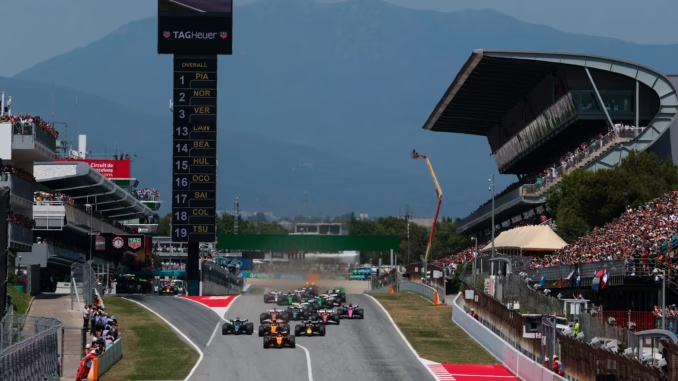
The European leg of the Formula 1 calendar is in full swing, and that means the grid is heading to a venue every driver, engineer, and fan knows like the back of their hand: the Circuit de Barcelona-Catalunya.
Located just outside the vibrant city of Barcelona in Montmeló, this track has been a staple of the F1 circus for over three decades. It is a circuit that strips away all hiding places—if a car works well here, it usually works well everywhere. To get you fully primed for the upcoming race weekend, we have rounded up 30 essential, surprising, and historic facts about the home of the Spanish Grand Prix.
Origins & Architecture
- Olympic Beginnings: The circuit opened in September 1991, just in time to host the start/finish line for the road team time trial cycling event at the 1992 Barcelona Summer Olympics.
- Immediate F1 Debut: It hosted its very first Formula 1 Spanish Grand Prix in 1991, only weeks after officially opening.
- The Predecessor: Before Montmeló took over, the Spanish Grand Prix bounced around several iconic venues, including the notoriously dangerous Montjuïc street circuit in Barcelona and the Jarama circuit near Madrid.
- The Ultimate Test: Because it features a perfect mix of high, medium, and low-speed corners alongside a massive straight, it was F1’s primary winter testing ground for decades.
- Windy Dynamics: The track is highly susceptible to shifting winds. A headwind down the main straight can become a sudden tailwind by the afternoon, completely altering a car’s aerodynamic balance.
Track Layout & Corner Trivia
- The Magic Number: In its current configuration, the track features 14 corners—8 right-handers and 6 left-handers.
- The Long Straight: The main pit straight is a staggering 1,047 meters (over a kilometer) long, giving drivers plenty of time to utilize DRS.
- R.I.P. The Chicane: In 2023, F1 permanently dropped the awkward, slow-speed chicane (RACC) at the end of the lap, reverting the final sector to its original, sweeping high-speed configuration.
- Turn 4 (Repsol): This is a long, blind, uphill right-hander that heavily punishes front-left tyres and serves as a classic spot for understeer frustration.
- Turn 9 (Campsa): An incredibly fast, blind uphill crest. Drivers tackle this corner at roughly 160 mph, relying purely on memory and downforce.
Historic Milestones & Record Breakers
- The Ultimate Record: Michael Schumacher and Lewis Hamilton share the record for the most wins at this circuit, with 6 victories each.
- Max’s Fairytale: In 2016, Max Verstappen won his debut race for Red Bull Racing here after Lewis Hamilton and Nico Rosberg famously crashed into each other. At 18 years and 228 days old, Verstappen became F1’s youngest-ever race winner.
- Pastor’s Miracle: In 2012, Pastor Maldonado shocked the sporting world by winning the Spanish Grand Prix for Williams. It remains one of the modern era’s biggest underdog victories.
- The Mansell vs. Senna Spark: The 1991 inaugural race featured one of F1’s most iconic images: Nigel Mansell and Ayrton Senna driving wheel-to-wheel down the main straight, sparks flying from their undertrays.
- Schumacher’s Masterclass: In 1996, Michael Schumacher took his first-ever win for Ferrari here during a torrential downpour, lapping the field up to third place in what is widely considered one of the greatest wet-weather drives of all time.
Pole Position & Strategy Realities
- Qualifying is King: Overtaking can be notoriously difficult here. Roughly 75% of all races at the circuit have been won from pole position.
- Front Row Lock: Winning from lower than the front row is rare. Only a handful of times has a driver won from third or lower on the grid (including Schumacher from 6th in 1996 and Fernando Alonso from 5th in 2013).
- Tyre Torture: The track surface and long, high-energy corners make this one of the most abrasive circuits on tyres all year. Pirelli routinely brings their hardest compound tyres to cope.
- Pit Lane Pain: Pit lane time loss is high here (roughly 22-23 seconds), which pushes teams to heavily favor a two-stop strategy rather than gambling on a three-stop.
- The Alonso Effect: Fernando Alonso’s home crowd is famously passionate. When he won in 2013 with Ferrari, grandstands turned into a sea of blue and red, sparking an security headache when fans stormed the track post-race to celebrate.
Fun, Quirky & Miscellaneous Facts
- Multi-Purpose Asset: F1 isn’t the only show in town. The track also hosts MotoGP (The Catalan GP), the World Superbike Championship, and various endurance racing series.
- The Walk of Fame: Just outside the paddock, there is an avenue where drivers who have won the Spanish Grand Prix leave their handprints in concrete blocks.
- Close to the Action: The grandstands are uniquely positioned on natural hillsides, giving spectators in certain spots a view of up to a third of the entire circuit at once.
- The 300km Club: A standard F1 race distance here covers 66 laps, totaling roughly 307 kilometers (191 miles).
- The Brawn Domination: In 2009, Jenson Button led a Brawn GP 1-2 finish here, cementing one of the most unbelievable fairytale starts to a season in F1 history.
- Engineers’ Nightmare: Teams have so much historical data from this track that engineers call it a “baseline” circuit. If a new upgrade doesn’t work in Barcelona, the team knows they have a fundamental issue with their wind tunnel data.
- The Red Bull 1-2 Legacy: Red Bull has a rich history here, but it was also the site of massive inter-team tension in 2010 when Mark Webber dominated the weekend ahead of Sebastian Vettel.
- High Speed, High G-Force: Drivers experience up to 4.5G of lateral force through Turn 3, a massive, looping right-hander that tests a driver’s neck muscles to the limit.
- Eco-Friendly Efforts: The circuit is heavily focused on sustainability and is one of the few global tracks to hold the FIA Three-Star Environmental Accreditation.
- Catalan Pride: While it is the Spanish Grand Prix, the track heavily embraces its regional roots. The Catalan flag is proudly flown alongside the Spanish national flag everywhere from the podium to the track marshal outposts.
From the high-speed thrills of Turn 9 to the tactical chess match played out in the pit lanes, the Circuit de Barcelona-Catalunya never fails to give us a clear picture of exactly where the hierarchy of the grid stands. Will we see another masterclass from the reigning champions, or is Barcelona cooking up another historical upset?
Grab your waffles, settle onto the sofa, and enjoy the race weekend!