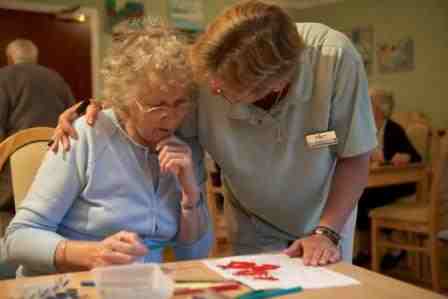
“I’m a nurse”
“oh really, what ward?”
“I work in an alzheimers and dementia unit”
“oh…….. I don’t know how you do that; I couldn’t”
Looking after any person takes desire, knowledge and care. Looking after a person with dementia takes that and a whole lot of patience.
When a family member is put into the position of carer, their role in the family automatically changes; whether they want it to or not.
The definition* of carer is someone of any age who provides unpaid support to family or friends who could not manage without this help. This could be caring for a relative, partner or friend who is ill, frail, disabled or has mental health or substance abuse problems. Anyone can become a carer: carers come from all walks of life, all cultures and can be of any age. Many feel they are doing what anyone else would do in their situation and just get on with it. Carers don’t choose to become carers: it just happens and they have to get on with it; if they do not do it, who would and what would happen to the person they care for?
*the Princess Royal Trust for Carers
Caring for the carers
When caring for someone in your own home, the stresses of caring are manifest:
- the physical burden ie toileting, feeding, washing and dressing all requires physical exertion
- the emotional burden, seeing a person suffer especially as the illness progress is hard for any one to deal with
- the difficulty in dealing with symptoms of mental disorders, 3 types of symptoms are especially distressing
- aggressive and agitated behaviour
- memory loss
- suicide attempts/threats re same
- the expense ‘the cost of care’ arranging assistance to help with care eg care packages thru the trust or nursing care
- loss of other activities eg work/hobbies
- loss of social contact (just because you choose to care for your loved one others may not be so keen to visit/join in)
As discussed in my second article, when it’s family that are doing the caring, they need support whilst they undertake the care of their loved one, and when to let the ‘professionals’ take on the load.
Caring in the community is a lifeline to many families who feel they can manage at home with trained carers coming in to assist with care. This is at specific times of the day with the role of assisting with a certain activity of living. Usually washing/rising from or getting into bed and toileting. Help also is provided by nurses where necessary.
Units specifically for care of the Elderly Mentally Infirmed (E.M.I.) are for those families whose family member need 24hr supervision, whether early onset- full nursing care and palliative care. I have the privilege of working in an EMI unit. I say privilege, as I meet someone that to me is ‘the whole package’. I don’t have memories of their past life, I’m not feeling angry, upset or emotionally challenged by the ravaging effect dementia has had, I’m not feeling guilty of wanting a break from the challenges. I choose to work in this field, I choose to work with these multi-faceted people, I choose to be placed in challenging situations. Why? Because I care. Working in a unit has it’s own difficulties; trying to give individual care in a large unit and not let routine dictate, is difficult at times. Staff levels, layout, types of residents and the varying stages of dementia, all put constraints on the delivery of care. Getting you head around time and that in our world it exists, in their world it does not. For instance, getting up at 4am, wanting washed dressed and breakfasted to then go to ‘work’ ie the Lounge to sleep!!
To be able to maintain safety, justify to family/inspectors why things have been done in a certain way or time, to deal with challenging patients and their equally challenging families. All wanting the same thing, their family member to get the highest standard of care. To work a 12 hr shift that can be long, laborious and repetitive one day and full tilt the next. To maintain palliative care in one room and sing songs in the next room. To maintain the copious amount of paperwork that has to be of a standard acceptable if challenged in a court of law. So much responsibility and that’s just the practical side.
The challenges of delivering care, administering the correct medications to suit the individual, to recognise signs of decline or ineffectiveness of medication, that in turn effects the patient and their mood/behaviour. Ensuring these vulnerable individuals don’t get abused whether physically mentally or through medications by ill-informed or untrained staff. Ensuring support from psychogeriatricians, social workers, care managers, GP’s and families to create an holistic plan of care.
To return to the start of this article, and the “I don’t know how you do that, I couldn’t”. I’m not sure why I can do what I do, but I have realised there are many who truly can’t do what I do. That is not a reflection on them, but working in the field of dementia is extremely challenging physically, mentally and emotionally. Where there are nurses who can work in A&E, cardiac, plastics etc all varying skills in the nursing role, so there are nurses who work in EMI care. That’s the joy of nursing it’s diversity.
For me I have a person who is lost, my job is not to find them, but make their journey easier to bear. To try and release them from their agitation and aggression, to remind them constantly when they forget, to reassure, to be patient during the repetitiveness,to interpret the non-verbal cues. To ensure the treatment they receive gives them some quality, that they have dignity and modesty, when they forget to behave appropriately, that they receive the respect they deserve.
Patience, time, wisdom.
I have been sworn at, spat at, hit, kicked, bitten, threatened,
I have been kissed, hugged, cried with, laughed with
I have had ‘gobble-de-gook’ conversations
I have had reminiscent conversations
I have had conversations where no words have passed, just maintaining eye contact and an understanding connection
The simplest things, a smile which changes an aggressive outburst to a hug and a kiss. The other side of the coin, where a smile is interpreted as sarcasm and triggers an onslaught of self abuse and abuse at the carers. You get to recognise that ‘mask’ that seems to slide across their face, one minute pleasantly confused, the next a raging force.
But it’s the connection that keeps me working in this field. Despite the challenging behaviour, the physical challenges, I love when I make that connection. We become like ‘family’ we are able to help share the load so the family are just that, family. They can enjoy the time with their loved one without the duty of care. They have staff to talk with, lean on, rely on…….
Someone there who has seen it before, yet treat each case individually.
The connection comes with it’s own set of downfalls, this is palliative care. They are not going to get better. When you make a connection, you feel the pain when they are dying, no matter how professional you are, you cannot work in this field without getting emotionally involved. You are there for the patient, but you are also grief counselling the family, leaving you bereft.
In a recent article I agreed with the writer re the importance of counselling support for nursing care staff; it’s sadly lacking, as this is our ‘job’. To do our job to the best of our ability we need support too. Yes I choose to work in this field, but as my own family know, when there’s a run of deaths in the unit, you cannot help but be affected by it and this in turn effects how you are in the rest of your life.
So the carers point of view; frustrating, tiring, emotionally challenging, physically challenging, rewarding, educational, entertaining, a privilege….
No matter how much training and how much head knowledge you have, if you don’t have empathy for the person you care for, you can’t care fully for them nor reap the benefits of knowing at the end of the shift you made a difference.
I don’t get paid much for what I’d do, but knowing I do my ‘job’ to the best of my ability. As contrived as it sounds, it’s more than worth it.
I hope these articles have been helpful and of interest. I by no means deem myself an expert but only share my feelings knowledge and experience in a personal way.
Soapgirl
Also See:
Dementia: the familiesview
