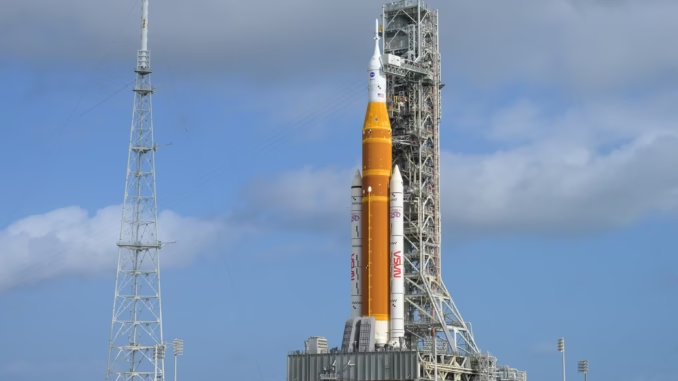
For the first time in over 50 years, astronauts are about to leave Earth and head toward the Moon — and it’s happening tomorrow.
NASA’s Artemis II mission is set to launch on Wednesday, 1 April 2026, from Kennedy Space Center in Florida. The two-hour launch window opens at 6:24 PM Eastern Time (that’s 11:24 PM here in the UK) and the countdown clock is already ticking.
Who’s on board?
The four-person crew consists of Commander Reid Wiseman, Pilot Victor Glover, and Mission Specialist Christina Koch from NASA, joined by Mission Specialist Jeremy Hansen from the Canadian Space Agency.
The mission will set several human spaceflight records: Glover will become the first person of colour, Koch the first woman, and Hansen the first non-US citizen to travel beyond low Earth orbit. These are genuinely historic firsts, and they’re happening in our lifetime.
What will they actually do?
The crew will first orbit Earth so they can check out key systems on their spacecraft, including life support, communication, and navigation. If everything goes as planned, they’ll fire their vehicle’s propulsion system to send themselves on a looping figure-eight path around the Moon and back — a deep space journey that will take them more than 230,000 miles from Earth.
Immediately after the rocket’s core stage separates, the crew won’t head for the Moon just yet. Instead, they’ll spend their first 24 hours in a High Earth Orbit — a safety-first approach designed to keep the astronauts close to home while they ensure Orion’s life-support systems are working perfectly.
The full mission is expected to last around ten days, with splashdown in the Pacific Ocean off the coast of San Diego.
Why isn’t anyone landing on the Moon?
Good question — and it’s one a lot of people are asking. Artemis II is a crucial test flight, designed to prove that the Orion spacecraft and its life support systems can safely carry humans to the Moon. Think of it as a dress rehearsal. A landing on the Moon could be attempted as early as 2028, but first NASA needs to know that everything works with real people on board.
How long has this been coming?
Over three years ago, during the Artemis I test flight in November and December of 2022, NASA sent an Orion capsule on a looping trip around the Moon without astronauts on board. That capsule covered over a million miles and lasted over three weeks before splashing down in the Pacific. Artemis II is the next step — and the big one.
It will be the first crewed mission beyond low Earth orbit since Apollo 17 in 1972. That’s 54 years. An entire generation — actually, two generations — have lived their whole lives without a human leaving the bounds of Earth orbit. That changes tomorrow.
Will it actually launch?
So far, so good. NASA completed the Artemis II Flight Readiness Review on Thursday, 12 March, and polled “go” to proceed toward launch. The weather forecast shows an 80% chance of favourable conditions, with cloud coverage and potential high winds being the main concerns.
NASA’s launch director Charlie Blackwell-Thompson told reporters that the run-up to the countdown start has gone extremely smoothly, with only a few minor ground equipment issues to deal with. When the launch director uses the word “smooth,” that’s about as reassuring as it gets.
How to watch
NASA will be streaming the launch live on their website and YouTube channel. With liftoff scheduled for just before midnight UK time, it’s the kind of thing worth staying up for. History doesn’t happen every night.