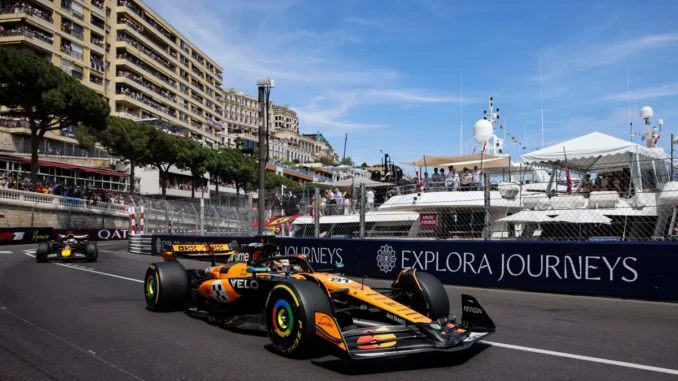
With the Formula 1 Monaco Grand Prix just around the corner, it’s time to dive deep into the most glamorous, most historic, and most unforgiving circuit on the calendar. From its origins on the streets of Monte Carlo to the legendary drivers who have mastered it, here are 40 facts about the Circuit de Monaco you might not know.
Origins & Planning
- The origins of the Monaco Grand Prix date back to 1929, when the inaugural race was the brainchild of Antony Noghès — a cigarette manufacturer and member of the Automobile Club de Monaco — who organised a race through the streets of Monaco and set the stage for what would become one of the most prestigious events in motorsport.
- The first Monaco Grand Prix was held on 14 April 1929 and won by William Grover-Williams driving a Bugatti.
- The circuit is located across La Condamine and Monte Carlo — two distinct districts of the tiny Principality of Monaco.
- Monaco became part of the very first Formula One World Championship season in 1950 — making it one of only a handful of circuits to have been on the F1 calendar since the sport’s inaugural year.
- Monaco has been held every year since 1955 with only one exception — the 1954 edition was skipped, making its near-unbroken streak across seven decades all the more remarkable.
- The Circuit de Monaco was designed by Antony Noghès and is driven clockwise — one of a small number of F1 circuits where cars travel in that direction.
- Constructing the Circuit de Monaco before a race weekend takes six weeks and more than 300 workers to set up — and a further three weeks to dismantle afterwards.
- Traditionally, Monaco paid a substantially lower yearly sanctioning fee to the owners of Formula 1 than other circuits — believed to be around half of what other venues pay. It is thought this may have changed following a contract renewal in 2022.
Track Facts & Specifications
- The current Grand Prix circuit measures 3.337 km (2.074 miles) in length and has 19 corners.
- The circuit has an FIA Grade 1 licence — the highest classification awarded to any racing venue in the world.
- Monaco is the only Formula One race that does not have to be at least 305 kilometres long — due to its low-speed layout and high concentration requirements, it runs to just 260 km instead.
- Drivers complete 78 laps of the circuit during the race — more than any other Grand Prix on the calendar.
- The Fairmont Hairpin — formerly known as the Station Hairpin and then the Loews Hairpin — is the slowest corner on the entire F1 calendar, taken at just 48 km/h.
- Nelson Piquet famously compared driving at Monaco to “riding a bicycle around your living room” — a quote that has never been bettered as a description of quite how absurdly tight the circuit is.
- Over the course of the 78-lap race, a driver will make almost 5,000 gear changes.
- The circuit runs through the famous tunnel section — one of the only circuits in the world where drivers go from full sunshine to darkness and back again at racing speed.
- The circuit has a spectator capacity of 37,000 — tiny by Formula 1 standards, but supplemented by thousands more watching from yachts in the harbour and from balconies and hotel rooms overlooking the track.
- The official race lap record for the current layout is 1:12.909, set by Lewis Hamilton in his Mercedes W12 during the 2021 Monaco Grand Prix.
Race History & Records
- The Circuit de Monaco has hosted 82 Formula One Grand Prix races between 1950 and 2026 — making it one of the most frequently visited circuits in the sport’s history.
- The most successful driver in the circuit’s history is Juan Manuel Fangio, with seven wins — though his record spans both the pre-championship era and the early World Championship years.
- Ayrton Senna holds the record for the most wins in the modern era with six victories — including an incredible five consecutive wins between 1989 and 1993.
- Graham Hill won five times at Monaco between 1963 and 1969, earning him the nickname “Mr Monaco” — a title he shares, in spirit at least, with Senna.
- Michael Schumacher also won five times at the circuit, between 1994 and 2001, and took the most fastest laps of any driver at Monaco — doing so five times during his career.
- For the entire decade between 1984 and 1993, the Monaco Grand Prix was won by only two drivers: Alain Prost and Ayrton Senna. Between them they shared ten consecutive victories in the Principality.
- McLaren have led more laps of the Monaco Grand Prix than any other team, completing 958 laps in the lead.
- Since 1950, there have been 5,676 F1 racing laps at the Circuit de Monaco. Fernando Alonso has completed the most racing laps of any driver in Monaco, overtaking Graham Hill’s 55-year-old record in 2022.
- Since 1950, 1,423 cars have started a Monaco Grand Prix — of those, only 749 have reached the chequered flag, giving an overall finish rate of just 53%.
- 44 different drivers have set the fastest lap of the Monaco Grand Prix across its history.
- Lando Norris won the Monaco Grand Prix for the first time in 2025, while Charles Leclerc took his first Monaco win in 2024.
Legendary Moments
- In 1955, Alberto Ascari crashed his Scuderia Lancia car into the Monaco harbour during the race. He survived with only a broken nose — a miraculous escape that demonstrated the extraordinary courage required to race at Monaco in its early years.
- The 1982 Monaco Grand Prix is one of the most chaotic races in F1 history. In the closing laps, five different leaders took the lead: Alain Prost crashed out, Riccardo Patrese spun, Didier Pironi and Andrea de Cesaris both ran out of fuel, and Derek Daly’s gearbox failed — before Patrese restarted his car to claim a remarkable first F1 victory.
- In 1984, Ayrton Senna burst onto the F1 scene in an unfancied Toleman car, chasing down championship leader Alain Prost in pouring rain and rising from 13th on the grid to second place — before the race was controversially red-flagged with Senna closing rapidly on the leader. Many still regard it as the moment the world realised a genius was coming.
- In 1988, Senna took pole position at Monaco by a stunning margin of 1.427 seconds over his nearest rival — one of the most dominant qualifying performances in Formula One history
- Senna’s 1992 Monaco win is one of the most dramatic in history. Championship leader Nigel Mansell led until lap 70 when a loose wheel nut forced him into the pits — Senna inherited the lead but Mansell, on fresh tyres, was eating into his advantage by almost two seconds a lap in the closing stages. A titanic duel through Monaco’s streets for the final three laps ended with Senna holding on to equal Graham Hill’s record of five wins.
- In 1996, Olivier Panis claimed one of the most unlikely wins in Monaco history, taking advantage of an accident-strewn field to win from sixth on the grid in what remains one of the race’s great surprise results.
- In 2008, Lewis Hamilton suffered a puncture early in the race but mounted a tremendous charge to take victory — one of the drives that confirmed him as a future world champion.
The Triple Crown & Wider Significance
- Monaco is one of the three races that make up motorsport’s Triple Crown — alongside the Indianapolis 500 and the 24 Hours of Le Mans. Winning all three is regarded as the ultimate achievement in motorsport.
- Graham Hill is the only driver in history to have won the Triple Crown of Motorsport — the Monaco Grand Prix, the Indianapolis 500, and the 24 Hours of Le Mans. He also, remarkably, did not pass his driving test until he was 24 years old.
- Monaco is the most exclusive of the three Triple Crown events — because while Indy and Le Mans accept single-race entries, the Monaco Grand Prix requires a full-time Formula One seat to participate, dramatically restricting who can even attempt it.
- The event is celebrated for its unique combination of historic tradition, challenging racing, and scenic beauty — and the continuity of the Monaco Grand Prix on the Formula 1 calendar since 1955 showcases its integral role in the sport both as a test of driving skill and as a symbol of the glamour and spectacle that Formula 1 embodies.
Whether you’re a lifelong F1 fan or a first-time viewer, the Monaco Grand Prix is unlike anything else in motorsport. There is no circuit like it on earth — and after 97 years, there never will be.