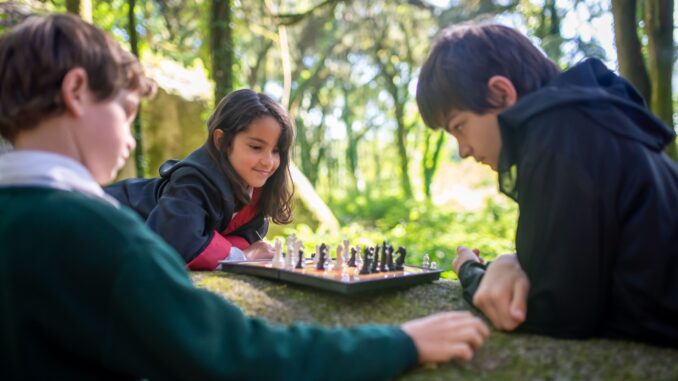
Parents worried about children growing up glued to screens and surrounded by artificial intelligence could find an unlikely secret weapon hiding in the cupboard.
The humble chessboard could help youngsters sharpen their concentration, rebuild post-Covid confidence and develop the creative thinking they may need to thrive in an AI-dominated world.
Kelvinside Rector Dan Wyatt said the ancient game is far more than moving kings and queens around a board, with every turn forcing children to assess risk, plan ahead and face the consequences of their decisions.
Mr Wyatt said: “Chess develops concentration, attention, memory, logical reasoning and the ability to plan and strategise.
“Every move asks a young person: if I move this piece here, what will my opponent do? Is that going to be good for me, or should I try something else?
“That kind of decision-making is so important in preparing young people for the world they are going to enter beyond school.”
While computers can calculate moves in seconds, Mr Wyatt said chess could strengthen the distinctly human skills that may become even more valuable as AI transforms classrooms and workplaces.
He said: “Human creativity is going to become more and more important as AI continues to develop.
“Players can learn different openings and forms of attack and defence, but they still have to find creative ways of responding to an opponent.
“You might play a very good player and lose five times. The next time, you have to think differently and try something new.
“That ability to assess risk, innovate and change your approach matters in chess, but it also matters in maths, science and life.”
The game could also provide parents with a low-cost way to prise children away from phones, tablets and games consoles.
Senior pupil Kanish, who has played chess for around eight years, said attending clubs cuts his screen time by at least four or five hours every week.
He said: “A longer game can last two hours, and for that whole time you are away from a screen, concentrating on something else and interacting with someone you might never have met before.
“Afterwards, you might sit together and analyse the game for another 15 or 20 minutes.
“I feel that touch of human interaction has been lost for a lot of people since Covid, and chess really helps bring it back.”
Kanish said tournaments also help him rebuild social skills affected by the pandemic by bringing him face-to-face with people of different ages, cultures and backgrounds.
He added: “During Covid, I felt that a lot of my social skills were lost.
“You might be on opposite sides during a match, but as soon as it is over, you can analyse the game together.
“It teaches you that being rivals does not mean you cannot be great friends afterwards.”
Mr Wyatt said chess could also teach children how to lose without throwing in the towel, with blunders, failed attacks and lost pieces all becoming valuable lessons.
He said: “Chess teaches patience, resilience and emotional control.
“Young people have to learn that it is okay to fail, lose and make mistakes, because that is how we learn.
“Chess teaches humility too. If you win, you still say, ‘Well done, well played’ to your opponent.”
It could even challenge fears that the scrolling generation has lost the ability to focus.
Mr Wyatt said: “Some children might struggle to concentrate during a lesson for ten minutes, but if they really enjoy chess, they can play for half an hour or much longer.
“That raises the question of whether the problem is really their ability to concentrate, or whether it is engagement.”
Parents do not need specialist knowledge, costly lessons or a budding grandmaster in the family to get started.
Mr Wyatt advised beginning with how each piece moves, keeping early games simple and making sure children understand that losing is not a disaster, but part of learning.
Photo by Kampus Production: https://www.pexels.com/photo/kids-playing-chess-7965823/

Leave a Reply