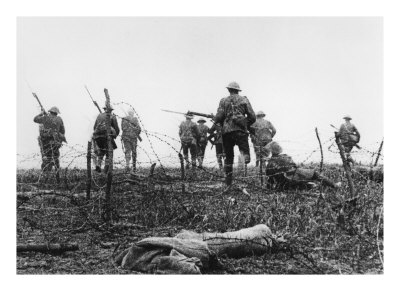
The Great War as it is known.
This is an article about the Brave men of the 36th Ulster Division who fought at the Battle of the Somme. Of the nine Victoria Crosses awarded on the 1st July 1916 Four went to the 36th Ulster Division.
“I am not an Ulsterman but yesterday, the 1st. July, as I followed their amazing attack, I felt that I would rather be an Ulsterman than anything else in the world.”
Cpt Wilfred Spender 2nd July 1916
The 36th (Ulster) Division was formed in September 1914, from the Ulster Volunteer Force raising thirteen battalions for the three Irish regiments based in Ulster, the Royal Inniskilling Fusiliers, the Royal Irish Fusiliers and the Royal Irish Rifles.
The men of the 36th used Helen’s Tower just outside Belfast as a training camp prior to their embarkation from Belfast for France and, for those soldiers, Helen’s Tower would have been a lasting image as they sailed out of Belfast Lough. In November 1921 a replica of the Tower was opened near Thiepval Wood and it was called the Ulster Tower.
Lord Kitchener met with Sir Edward Carson in London and asked him could he raised a Divison for the so-called New Army.
Within days Carson had placed an order for 10,000 uniforms with a London firm of outfitters. The volunteers were quickly kitted out in their new uniforms unlike recruits elsewhere in Britain.
In July 1915, the Division moved to Seaford, on the Sussex coast of England. This was the first time that many of the men had been outside their native Ireland. Kitchener inspected the Division there on 27 July 1915, and later remarked to Carson “your Division of Ulstermen is the finest I have yet seen”
In October 1915 after several months of preparation in England, men of the 36th Ulster Division sailed across the Channel and began to disembark in France.
In March 1916 the Ulster Division were sent to an area called Thiepval Wood. This wood, the name of which would become indelibly linked to the province of Ulster, served as a base until the commencement of the Battle of the Somme on 1st July 1916.
On the 1st of July a date the 36th Ulster Division had been ordered out from the wood just before 7.30am at zero hour the British barrage lifted. Bugles blew the “Advance”. Up sprang the Ulstermen and( Many with their Orange Sashes on shouting NO Surrender ), without forming up in the waves adopted by other divisions, they rushed the German front line. The Ulstermen had gained an advantage on the day of battle by not sticking to the rigid orders issued. Both the German and British generals considered the men of the New Army/Kitcheners Men as insufficiently trained in the skills of warfare. Consequently, the battle tactics they were ordered to follow by commanders was more strict and regimented than those of regular army.
They advanced, moving to the crest so rapidly that the Germans had no time to come up from their dugouts (generally 30′-40′ below ground) in the Schwaben Reboubt, which was also taken. So successful was the advance that by 10:00 some had reached the German second line. But again they came under their own barrage, not due to finish until 10:10. However, this successful penetration had to be given up before nightfall, as it was unmatched by those at its flanks. The Ulstermen were exposed in a narrow salient, open to attack on three sides. They were running out of ammunition and supplies, and a full German counter-attack at 22:00 forced them to withdraw, giving up virtually all they gained.
The 36th Ulster Division was relieved on 2nd July, having suffered 5104 casualties of who approximately 2069 died.
Of nine Victoria Crosses given to British forces in the battle, four were awarded to 36th Ulster Division soldiers
After the war had ended, King George V. paid the following tribute to the 36th Division saying;
“Throughout the long years of struggle … the men of Ulster have proved how nobly they fight and die …”
We will remember them

Good read.
Lions led by donkeys is how the Germans described us as we launched wave after wave of suicidal missions into a hail of machine gunfire.
Might I suggest a read of Ken Follett’s mighty tome Fall of Giants? I’ve just finished it. It is set around The Great War and features The Somme and its mad, pointless slaughter.