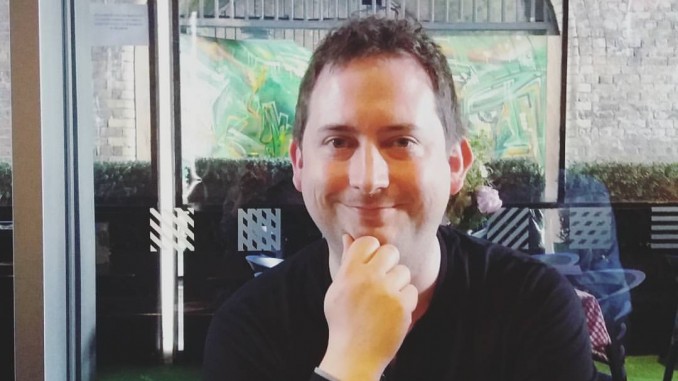
Andrew Lawston is a London-based writer and amateur actor. His work can be found in various anthologies, including Sanity Clause Is Coming, and his own self-published collections, Something Nice and Something Nicer.
Andrew’s work mostly takes the form of short stories, which have been hailed as “funny”, “quirky”, “horrific” and “twisted”. Often all at once. A fluent French speaker and former teacher, Andrew supplements his short story writing with French translations. Casanova’s “Story of My Escape” was published in 2014 to the delight of English-speaking Casanova enthusiasts around the world, and further translations are in the pipeline of early 20th Century French novels.
In addition to his original fiction, Andrew has also placed Doctor Who stories in several charity anthologies, including The Cat That Walked Through Time, and Shelf Life.
Tell us a little about yourself and your background?
I’m from a cosy town on the edge of the New Forest in Hampshire. Looking back, with all the tramping across fields, and building dens at the bottom of our garden, growing up was probably pretty close to idyllic, but you don’t have anything to benchmark against when you’re a kid. Mum was from Solihull originally, but Stratford-upon-Avon was always her spiritual home, and we went to see a lot of theatre, as soon as we were old enough.
These days I live and work in South West London, running the advertising on a large membership magazine. I live with an aloof black cat, an insane cocker spaniel puppy, and my wife Melanie. I’m a fluent French speaker thanks to my French degree and an ill-advised attempt to become a French teacher. I’ve also done a lot of acting over the years, mostly amateur but increasingly professional recently.
What were you like at school?
I was bright enough to stand out at a rural comprehensive, and stupid enough to let it show. I was picked on a bit, but for a while I was big for my age, and I knocked the snot out of a couple of bullies. I was given just enough grief – and saw friends and family getting even more – that I retain an extreme hatred of bullying in all its forms to this day.
In terms of the actual classroom, I was naturally lazy. If I was keen on a subject, I’d put a stupid amount of effort in, but if I wasn’t, well… a good example was my Technology GCSE coursework. On the graphic design side, I spent months putting together the instructions and packaging design for a Doctor Who computer game, and scored a top A*. For woodwork, I handed in two splintered pieces of wood and a scuffed picture of a chess board.
Were you good at English?
I was, definitely. But, at first, I was only good at the creative writing bits. When we started “studying” books, I’d be horribly precociously critical of the proto-YA dreck they used to foist on us in the early 1990s. I’d say horrendous things like “I just think this depiction of disability pales next to Smike in Nicholas Nickleby” to show off that I’d read a bit of Dickens, when really I was hacked off that we weren’t studying the Timewyrm novels. I would have hated to teach me.
What was your first job?
I was the Saturday help at our local independent bookshop for £3 an hour, mostly checking off the incoming order against the delivery note. I knew, with a certainty that seems troubling now, that it would be the best job I’d ever have, and it’s just depressing that it really really was. And that’s without even mentioning the 25% discount! They’d give me an envelope with cash every Saturday evening, and often I’d spent it all before leaving the shop.
So, what have you written so far?
The bulk of my fiction work so far has been short stories, published in various small press magazines, anthologies, blogs, and latterly self-published. I’ve also translated two French books: Story Of My Escape (Casanova’s memoir detailing his celebrated escape from “the Leads” prison in Venice in 1755), and Chantecoq and the Aubry Affair, a pulpy Arthur Bernède thriller written just before the First World War. I also self-published my MPhil thesis on the depiction of violence in the early films of Jean-Luc Godard.
When did you know you wanted to write?
I was 6, it was a wet half-term and I wrote a two page story about a superhero called “Road-Driller”, who looked like the Incredible Hulk but with a pneumatic drill on his head. Two years later, I wrote a Doctor Who story that started with the line “He was running. They were after him.” I’ve been writing in some form or other pretty much ever since. Terrance Dicks got to me, what can I say?
How did you begin writing?
After wildly optimistic attempts to submit to Virgin’s Doctor Who – New Adventures range, I started writing for public consumption on alt.drwho.creative in the late 90s. Drabbles and crossovers and general silliness. It was a great playground that taught me a lot – and gave me great encouragement. After about six months of nothing but fanfiction, I was ready to start having a bash at some original stories. Throughout my school days my fiction had received good feedback, but always with the caveat that it was a bit “quirky”, from teachers who were terrified I was going to freak out an examiner. It made me a bit reticent to share my work at university, and it took the Internet to build me back up a bit. I can’t think why any new writer wouldn’t start with fanfiction these days. You can take all the characters and settings out of the box and just get on with honing the nuts and bolts of your writing game.
You had stories placed in the Doctor Who charity anthologies Shelf Life (2008) and Cat That Walked Through Time (2000). How did your involvement in these anthologies come about?
I love charity anthologies! I started writing a little too late for Drabble Who, and was rejected from Perfect Timing. Alryssa Kelly announced Cat That Walked Through Time in alt.drwho.creative, and I’d just finished this weird Third Doctor Bond pastiche piece which recast Jo Grant as a lethally efficient agent who pretended to be a dizzy bombshell in order to make the Doctor feel better about hanging out with a soldier. Alryssa liked the bits and pieces I’d been posting in the newsgroup and accepted it from a one sentence summary.
Shelf Life was a bit more involved. I was a Livejournal acquaintance of Adrian Middleton, who wanted to do something to pay tribute to Craig Hinton, following his tragically early death in 2006. I was one of the first to volunteer a story, but then a week before the deadline, I left a virtually complete first draft on a train to Bognor Regis! I had to rewrite from memory and my most basic notes in a couple of days, but I think the story ended up stronger for it! I included scenes set on Warwick University’s campus, where I’d done my teacher training and where I knew Craig had once studied. The story was a blend of his Millennial Rites and my favourite French film, Pierrot le Fou.
Let’s talk about your short story collections, Something Nice and Something Nicer. How did the idea for your first short story collection originate?
Cool! The story that I tell about Something Nice is that my mum is always very supportive about my writing until she finds out about the latest demonic clown, murderous neighbour or haunted photocopier, at which point she always says “why don’t you write something nice?” which is where I got the idea for my first collection. This is all true, and she wasn’t flattered by my choice of title, unfortunately. But it really was the spark that gave me the idea to collect my fiction.
Where did you first get the idea to do a collection of short stories?
It was earlyish 2012, and everyone had just got a Kindle for Christmas. A few friends were announcing that they were going to write something and self-publish it, and I remembered that I already had a number of short stories for which all the rights had reverted to me. I cobbled together a Word file, took a photo of a pint of beer in a pub garden for the cover, and it was up on Amazon about four days later. It’s sold pretty well for a collection of short stories, but to be honest it was almost a whim!
What is it about the short story genre that appeals to you?
I like the idea of a story that can be told in a single sitting, just big enough for people to carry it around in their heads in its entirety. I love novels, but there’s something very pure about a short story that is exactly the length it needs to be. From a practical point of view, I also have periods where I can’t do much writing. The day job might get in the way, last year it was my wedding, and I do a fair bit of acting as well. I find these disruptions can really throw me off my stride with a longer piece, so the compressed timescale for writing a short story helps me focus.
How long did it take you to complete these collections?
The stories in Something Nice took just over ten years to write, as the first story was written in early 2000, and the last in early 2011. But I wrote a lot of internet content stuff and other things during that time as well. Something Nicer took just under three years, and I was a bit more focused on fiction throughout that time. I believe in waiting for the right idea to come along, and I was happy to take time out to work on translation projects and other bits of writing in the weeks and months when I couldn’t think of the next story.
What were some of the themes you wanted to explore in your collections?
I didn’t think I was a thematic sort of writer, I aim for more of a “wouldn’t it be cool if…” approach, but now I think about it a lot of my stories deal with people who are reluctant to let go of elements of their youth. There’s a university student who still believes in a demonic clown hiding under his bed, and a middle-aged man who’s had an alien best friend hiding in the garage since he was eight years old. There’s an apparently successful businessman who returns home to pursue a teenage crush, and a deeply unpleasant father who projects his own unhappy childhood on to his son. The emphasis on parental themes in my stories always strikes me as a bit odd, as well.
How do you feel about your stories after you’re done writing them?
Once the writing and editing is done, I’m generally unsentimental about my stories. I submit them if they’re for an anthology, or file them if they’re for a future collection, and I don’t tend to look at them again until it comes to publication time. Having said that, occasionally I am particularly proud of a finished story – sometimes I feel I’ve achieved everything I set out to do, and I can submit it with a smile and no second thoughts.
What is your writing process? How many hours a day to you devote to writing?
My process is quite haphazard. I do a lot of my first drafts in notebooks with a cartridge pen. I’m working my way through a bag of coloured ink cartridges at the moment, so I’m working in pink ink right now. Next up is a yellow one, and I really don’t know how legible that’s likely to be. When I come to type up a first draft, I edit on the fly, so it’s almost a free draft. When I am writing longhand, it tends to be in the pub. I can write through three pints in a couple of hours and get a good 500 – 1,000 words down. After that, things get a little wobbly! Whether I’m in the pub or on the laptop at home, I try to devote at least one hour a day to writing. Sometimes that’s my lunch hour at the day job…
What authors do you like to read? What book or books have had a strong influence on you or your writing?
I’m never quite sure which authors have influenced me, and which I just really like reading. I love Terry Pratchett (I’ve got his last six or so books, unread, and am rationing myself through them to delay the dreadful day when I’ll never again read a brand new Terry Pratchett book for the first time), Charles Dickens, Voltaire, Camus and Casanova. Blame my French degree for those last three. Angela Carter, Paul Magrs, Ben Aaronovitch, Jean-Paul Sartre, Sarah Pinborough, Jasper Fforde, Anne McCaffrey, Douglas Coupland, Mary Shelley, Christopher Brookmyre, Alastair Reynolds, Umberto Eco, Kate Griffin and Douglas Adams are also favourites. I also read a lot of Neil Gaiman, but I find a lot of his stuff faintly irritating without really knowing why. I really try to read a bit of everything, from self-published crap to the kind of books that are so highly crafted that you feel like you’re becoming slightly more intelligent with every paragraph that you read. Foucault’s Pendulum is my all-time favourite book this week, a work that pisses all over Dan Brown’s Da Vinci Code despite being written about a decade earlier. Masterful stuff.
What’s your advice to aspiring authors?
1) Read a lot, if for no other reason than watering down your most obvious influences. Everything I wrote before the age of eighteen has so much Terry Pratchett and Terrance Dicks in it that you could probably clone them both from my prose.
2) Submit your work to agents, editors, contests, tutors. Even if you’re ultimately thinking of doing the self-publishing thing, which is totally fair enough in itself, you need objective critique of your work before you put it in front of a paying audience. Respect your peers, and don’t become one of those strangely angry writers who use phrases like “so-called experts” and “dead tree publishing” on forums. That’s not the way to get invited to the best parties.
3) Be incredibly wary of anyone who wants money from you. Self-publishing has muddied the waters on this a little, in that you definitely need to stump up the cash on a decent cover for your work, but the old adage that money ought to be flowing towards the writer still holds true.
What are your ambitions for your writing career?
I’m in the process of stepping up to longer works, so my immediate ambition is to finish a solid novel. Longer term, I’d like to keep exploring genres and surprising readers. I have notes for a play I’d like to write. It might be interesting to get into script writing, whether audio or TV / film. I feel as though I’ve not really found my niche, so I’m keen to go on trying different things until something clicks, really.
What are you working on at the minute? Do you have any upcoming projects?
I’ve got quite a few Word files open at the moment, but I’m mostly working on a superhero retelling of obscure Grimm fairy tale The Mouse, The Bird and The Sausage, and the first in what will hopefully be a series of novels about my crime-solving cat. I’ve also got most of a zombie novella written. That’s probably my “sell-out” book, apart from the bit that features “combat juggling” and a zombie Roger McGough.
Is there anything unique about yourself that you would like your readers to know?
I do a bit of acting, and I’ll be briefly visible as an extra in a new Stephen Poliakoff drama in the Autumn, and will be appearing in a Chiswick amateur production of The Ladykillers in October!
Is there anything else you would like to add that I haven’t?
Ah, not really – I think I’ve rambled on far too long already!
How can readers discover more about you and you work?
I have a stupidly ill-maintained blog up at http://andrewlawston.blogspot.co.uk, and a mailing list at http://eepurl.com/bbRpnD which (when I get over a dozen subscribers) will receive occasional updates of new releases, previews, and special offers for my books.
Where can we buy or see you work?
(links should take you to your local Amazon site)
Something Nice – $0.99 / £0.99 http://authl.it/yq?d
Something Nicer – $0.99 / £0.99 http://authl.it/2s1?d
Neil’s Farrago – $0.99 / £0.99 http://authl.it/3dy?d
Story Of My Escape (Casanova translation) – $3.49 / £2.32 http://authl.it/15k?d
Chantecoq & The Aubry Affait (Bernède translation) – $3.99 / £2.99 http://authl.it/4e4?d
Also, my Christmas short story Pantocrime will be available as a free Kindle download from 15-17 July 2016, and then permanently from October 2016 onwards. It can be found at http://authl.it/59j
Thank you for your time!
Thanks, it’s been awesome!
Author bio: James Gent is a freelance writer; passionate about pop culture, books & book people, and social media. He has contributed to several published anthologies including 1001 TV Series You Must Watch Before You Die, penned the group biography for the official Monty Python website, and is currently editing Me And The Starman, a tribute to David Bowie, to be published by Watching Books later this year. Follow James on Twitter, LinkedIn and WordPress.