The UK is home to some of the most stunning and well-protected historical architecture in Europe. British architectural history and design, from Gothic churches to Regency buildings, is written on the walls everywhere you go.
That being said, if you are planning a few mini-breaks or staycations this summer, where will you find the largest range of historical buildings to visit and admire?
South East England is home to some of the oldest structures in the UK, including the oldest recorded town, Colchester. The region is a prime location for lovers of history, design and architecture to visit, with a range of quaint market towns close to England’s historic capital – London.
With help from the aluminium window and period design experts at The Heritage Window Company, we’ve collated data from Historic England to definitively rank the towns and cities in South East England with the most historic buildings.
Is your town on the list? Dive in and find out.
10. Southend-on-Sea (62 listed buildings)
A historic town on the Thames Estuary in Essex, Southend-On-Sea comes in at the bottom of this list with 62 listedbuildings. Despite having the fewest listed buildings on this list, the buildings on offer here are simply stunning.
Chosen for its brilliant fusion of Gothic and Tudor architecture, South Church Hall is a shining example of beautiful Tudor aesthetics and English design heritage.
First listed on Historic England in 1951, the hall was constructed between 1321 and 1364 and later extended in 1560 by Tudor architects. South Church Hall was home to farming families until the 1920s, extensively restored in the 1930s and even listed in England’s Thousand Best Houses by Simon Jenkins.
The hall is open to visitors at certain times of the year, making it a wonderful location to visit and soak up the community’s local history.

9. Luton (85 listed buildings)
Close to the River Lea and the Roman’s Icknield Way, Luton was a well-established town of 700 people by 1086. Throughout the centuries Luton had become known for its booming hat and automotive industry, established in the 1600s and 1900s respectively.
Luton’s buildings are largely characterised by 1930s architecture, including a town hall, churches, cinemas and private residences.
The oldest building in Luton, St Mary’s Parish Church is 850 years old – although people have been worshipping at the site for thousands of years. The church has been tastefully restored over the years, respecting its beautiful architecture whilstadding much-needed modern amenities and crucial repairs, installing heating systems and rectifying the church’s pulpit.
Guests are welcome daily at St Mary’s Parish Church and it’s well worth a visit, being the largest medieval church in Bedfordshire.
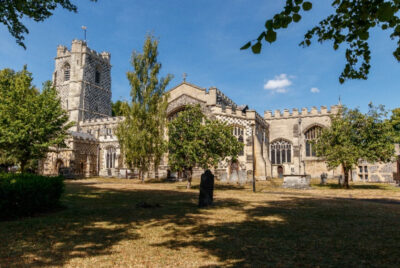
8. Basildon (125 listed buildings)
One of the more recently formed towns on this list, Basildon was established in 1949 to alleviate the housing crisis following World War II. The town became an extension and borough of Essex, built around establishing sites of historical interest – which to no surprise – are incredibly beautiful in their construction and design.
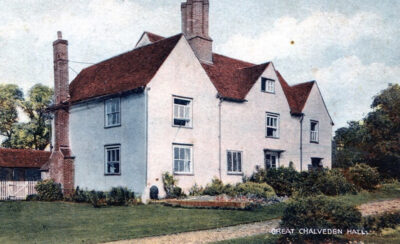
One of the most unassuming properties on this list, Great Chalveldon Hall is known by locals as a quirky Grade II listed pub dating back to sometime in the 16th century. This large white building with oddly placed windows hides a piece of English history, however – one that charms locals and visitors to this day.
Built into the attic of the pub is a hidden panel dating back to Queen Elizabeth I’s reign. This hideaway is what historians refer to as a “priest hole”, a hidden compartment used by Catholic priests being persecuted by the monarch.
Hidden behind a cupboard, the priest hole led to an elaborate escape tunnel which allowed the local priest to escape to the Pitsea marches. Unfortunately, the tunnel collapsed in the 1700s, but the priest hole remains a poignant reminder of the building’s rich local history.
7. Eastbourne (128 listed buildings)
Eastbourne was officially established in 1850 and stands on the ruins of the Roman city Anderida, with the only remaining visible landmark being the entrance to Longus Portus – Anderida’s harbour.
Today, Eastbourne is known as a beautiful seaside town ideal for a summer getaway. Close to South Downs National Parkand offering as much fish and chips as you can manage, Eastbourne is full of things to do and beautiful historic buildings to see.
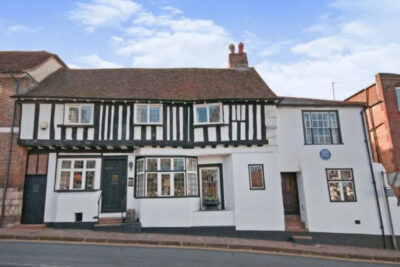
Built in 1134 and thought by some to be the oldest residential home in England, Pilgrim House (opposite The Lamb Inn) is believed to have been built by the monks of Lewes Priory as a hostel. One thing’s for sure – it’s definitely the oldest surviving house in the region.
Full of all the quirks you’d expect from a house restoredcountless times over the centuries, Pilgrims House is one of the most intriguing residential properties in South East England.
6. Dartford (282 listed buildings)
Another Roman settlement, Dartford is a market town with industrial roots at its core. Relative to its size, Dartford is full of beautiful historic properties and ancient parishes. For lovers of history, Dartford also holds the title of the first town with a modern museum, aptly named The Dartford Museum.
Found on Shepherds Lane, the original schoolhouse was built in 1864 and is referred to as the Hardy Building – named after Thomas Hardy, novelist and assistant architect to Arthur Blomfield, the building’s designer.
Its striking appearance makes the school truly unique in the local area. The tower on the frontage gives it an almostmedieval feel and a sophisticated touch of class. The rest of the school has developed significantly over the years, adding more buildings named after famous artists and alumni of note, including The Rolling Stones’ Mick Jagger.

5. Colchester (382 listed buildings)
Originally a Celtic tribe, Colchester has developed considerably since it was first put on the map by the Romans in 44 AD as the first Roman city in England. These days, Colchester is best known for being England’s oldest recorded town and having the largest Norman Keep in Europe, Colchester Castle.
Its age as a settlement lends itself perfectly to having plenty of beautiful listed buildings, making it a great location to visit for architecture lovers and history buffs.
St John’s Abbey was founded in 1095 by Eudo Dapifer, William the Conqueror’s High Steward. The Gatehouse is a tremendously imposing structure drenched in English history. In the late 14th century, the Gatehouse was added to the abbey to strengthen its defences following the result of the Peasants’ Revolt of 1381.
The building itself is two stories with a battlemented roof, turrets at each corner and large pinnacles. The northern-facing side is decorated beautifully with flintwork panels and ornamented niches. The gatehouse makes a strong statement about the strength of the abbey to all that gaze upon it, which is appropriate as it is one of the few abbeys that refused to surrender to Henry VIII’s Commissioners during the Suppression.

4. Bromley (415 listed buildings)
Now one of the most important commercial and shopping centres in the South East, Bromley was originally created as an Anglo-Saxon settlement sometime after the Romans left England. The name Bromley itself is derived from the Anglo-Saxon word Bromleag, first recorded in 862 AD, meaning “the place where broom grows”.
Bromley suffered a considerable architectural loss in 1936, when a fire destroyed the Crystal Palace, a steel and glass exhibition hall at Penge. This building was relocated in 1854 from Hyde Park.
Despite this loss, Bromley still boasts many beautiful and impressive listed buildings.
We love seeing old civil service buildings kept in beautiful condition and used for their intended purpose, the Bromley Police Station and Stables is certainly no different.
With additions and renovations in 1903 by John Dixon Butler and its original construction in 1854 by Charles Reeves, this Grade II listed building boasts a powerful design apt for its civil protection duties.
It has a contemporary baroque façade, stunning sash windows, a cell block which housed Sylvia Pankhurst and it was once home to a married inspector, constable and forty unmarried constables. This building has stood the test of time thanks to brilliant restoration work and incredibly strong architectural foundations.

3. Canterbury (1,880 listed buildings)
The beginnings of Canterbury were first recorded as the main settlement of the Cantiaci tribe before the Romans captured itin the first century AD, rebuilding it with a theatre, temple, public baths and more. The city has been a site of importance for pilgrims since the assassination of Archbishop Thomas Becket in 1170, and today it is one of England’s most beautiful historic cities.
In the modern day, Canterbury has been awarded UNESCO World Heritage status for part of the city, including the beautiful Church of St Martin.
Notably the oldest parish church in England still used as a church, this supposedly is the site where Queen Bertha worshipped with her chaplain Bishop Liudhard. Architecturally, the church is notably historic with Saxon frontage and an exterior built with flint, Roman brick and rubble.
The church is believed to have been built sometime before 597 AD and has a unique design thanks to its conversion into a Romeo-British church.
This building is truly a relic of Anglo-Roman design and it is a must-see if you find yourself in Canterbury.
2. Maidstone (2,024 listed buildings)

A town with a history steeped in battles, witches, industrialists and more, Maidstone is chock-full of listed buildings, the second most in South East England. The town has also become synonymous with the Iguanodon dinosaur since the species was discovered during a quarry excavation in 1834.
Once a small Roman farming community, Maidstone has been inhabited by Romans, Anglo-Saxons, Vikings and Normans over its colourful history – leaving behind thousands of beautiful listed buildings for modern-day Brits to appreciate.
Founded in 1395 by Archbishop Courtenay, The College of All Saints was an ecclesiastical college and part of the Archbishop’s Palace establishment. After the 1546 Chantries Act, the church and college were separated, with the college eventually being granted to George Brooke, Baron Cobham in 1549.
The Archbishop’s Palace and the Tithe Barn Stables are also fantastic locations that we strongly advise you visit, but we have chosen to put emphasis on the Gateway and Tower as they are one of the most beautiful entrances to a historic site in South East England.
Walking through the College Gateway feels like a portal into the past and it should not be missed by any lover of history or architecture.

1. London (19,322 listed buildings)
It should come as no surprise that London tops this list, racking up an astronomical 19,322 listed buildings. London has long been the jewel in England’s architectural and historical crown, home to England’s courts, parliament and six royal palaces.
With so many beautiful listed buildings in London, visitors are spoilt for choice. To narrow down our pick, we asked Kevin Brown, Managing Director at The Heritage Window Company, for his favourite listed building in London.
“All Hallows Church is one of the oldest in England – it’s full of history and architecturally it’s beautifully unique,” says Kevin. “Built in 1658, it suffered fire damage in World War II and it’s still standing with its copper steeple pointing into the sky.
“When I’m in the area, I love admiring the long windows that cascade down the side of the church. They add so much character to one of the most interesting churches in the country. It’s a shining example of architecture that fuses Anglo-Saxon and Roman design in a way which creates its own identity.”

Did your town or city make the cut? If not, at least you know where to plan for your next staycation.
