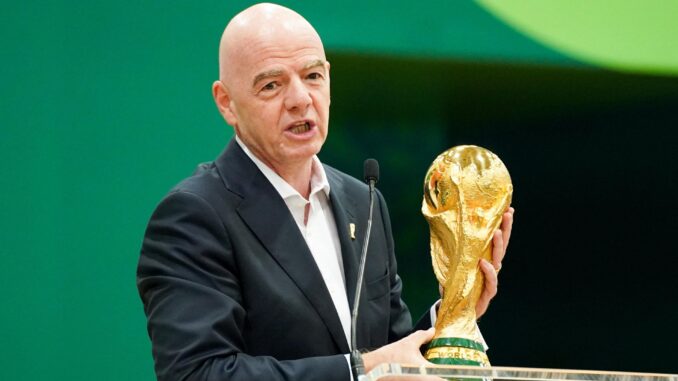
If there’s one thing modern football fans can agree on, it’s that following FIFA’s decision-making process often feels like playing chess against someone who keeps changing the rules halfway through the match. But today, the game has shifted off the pitch in a massive way.
The English Football Association (FA) is officially preparing to write to FIFA President Gianni Infantino to formally withdraw its backing for his re-election bid. The move comes right on the heels of the Football Association of Wales (FAW), who became the first governing body to publicly strip their support for Infantino earlier today.
So, how did we get here? What was the straw that broke the camel’s back, and could this mean the end of Infantino’s decade-long reign at the peak of world football? Grab a brew—let’s break down the whole saga.
The Doomed World Cup Sell-Off: FIFA Forward Enterprise (FFE)
The immediate catalyst for this revolt is a controversial plan cooked up by FIFA to create a commercial subsidiary named FIFA Forward Enterprise (FFE).
The idea? FIFA wanted to invite private equity investors to buy minority stakes in world football’s crown jewels—most notably, the FIFA World Cup and its expanded tournaments. The ambition was to raise billions (up to $4.2 billion, according to reports).
However, the response from European and American football authorities was anything but welcoming. UEFA (along with CONCACAF and the Asian Football Confederation) fired back immediately. Beyond widespread public outrage, UEFA went as far as threatening full-scale legal action, regulatory complaints, and even floating the nuclear option: a European boycott of FIFA competitions.
Realising he had stepped into a minefield, Infantino rapidly backtracked and scrapped the FFE plan. But for many within the game, the damage to trust and governance was already done.
“Loss of Confidence”: Wales and England Take a Stand
Reversing the proposal hasn’t stopped the backlash. The Welsh FA pulled no punches in their public statement:
“The recent failures in good governance, processes, leadership, values, stakeholder management, communications and sound judgement have led us to a position where Mr Infantino has lost the confidence of the FAW.”
Now, England’s FA is set to follow suit by pulling its endorsement for Infantino’s 2027–2031 presidential campaign.
With UEFA holding massive political clout and European nations beginning to form a united front, Infantino—who has ruled Zurich with a firm grip since taking over from Sepp Blatter in 2016—suddenly looks remarkably vulnerable.
The Broader Saga: A Pattern of Friction
This latest private equity debacle isn’t happening in a vacuum. It comes after years of mounting frustration between European football bodies and FIFA:
- Expanding Tournaments: From expanding the World Cup to a mammoth format to introducing the bloated 32-team Club World Cup, players and domestic leagues have complained bitterly about fixture congestion and player burnout.
- The “American Century” and Ticket Prices: Complaints around 2026 World Cup ticket pricing schemes and host city logistics have left supporters feeling increasingly priced out.
- Communication Breakdown: Executives within FIFA have reportedly voiced frustration over top-down decision-making and a lack of transparency regarding long-term commercial moves.
What Happens Next?
Is this the beginning of the end for Gianni Infantino?
To lose the support of major European associations like England and Wales—with potentially more continental FAs following suit—is a crushing blow to his campaign for another term. While Infantino has historically relied on strong voting blocs across Africa and the Americas, a open revolt from UEFA creates a deep schism at the top of world football.
Whether Infantino digs in his heels or an opposition candidate emerges to challenge him for the 2027 election, one thing is clear: the relationship between the custodians of British football and FIFA’s hierarchy has hit rock bottom.