The research found that Americans are most open to AI when there is a clear, straightforward outcome.
Finding store opening hours was the closest scenario to an even split, with 33% preferring an AI agent and 34% preferring a human. Similar attitudes appeared for routine tasks such as tracking an order or delivery (31% AI preference) and checking an account balance (30% AI preference).
But as soon as a situation involves responsibility, financial risk or emotional consequences, preference shifts strongly towards humans.
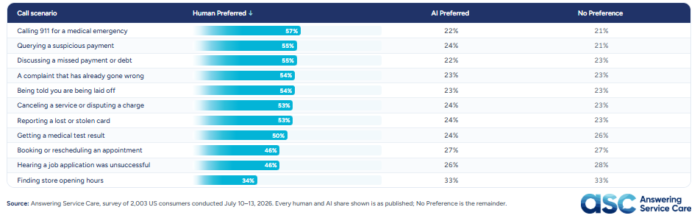
The findings suggest that the dividing line is not whether AI can complete a task, it is whether customers need someone to understand the situation, take responsibility and provide reassurance, as 12% of Americans have cried on a call to a business.
What sends people to a human is that it’s easier to discuss a complicated problem (40%), money at stake (39%), something already gone wrong (38%), and wanting someone to take responsibility (36%); accountability they feel AI can’t offer.
However, the people who think AI is the easier choice say it”s quick and simple (26%), and available any time, day or night (23%).
Americans will trade speed for a human when the issue matters
While speed is often seen as one of AI’s biggest advantages, the research shows many Americans are willing to sacrifice convenience for human support.
Nearly two-thirds of Americans (64%) said they would wait longer to reach a human if the issue was important.
Americans will wait an average of 11 minutes on hold to reach a human on a routine call, rising to 12.3 minutes when the call is sensitive – patience grows with the stakes.
Younger generations are more patient
Younger Americans were particularly willing to wait. Those aged 18–24 said they would wait 17 minutes for a human on a routine call and 19 minutes for a sensitive call, compared with just 7 and 9 minutes respectively among people aged 55 and over.
San Antonio is the city willing to wait the longest, waiting 20.12 minutes on average for a routine call, rising to 21.48 minutes for a sensitive call.
San Diego is the least patient; respondents only wanted to wait 3.64 minutes for a routine call, but it rises to 9.36 minutes for a sensitive one.
Healthcare and financial services face the strongest demand for human support, despite being the most stressful for Americans
The industries where Americans most want a human voice to answer the call:
| Industry | Preference for a human |
| Healthcare providers | 38% |
| Banks and financial services | 34% |
| Government agencies | 23% |
| Utilities (e.g. gas, water, electricity, internet) | 23% |
| Funeral homes and bereavement services | 22% |
| Legal service or solicitors | 19% |
| Employers or HR department | 18% |
| Insurance | 16% |
| Airlines and travel | 12% |
| Phone and broadband providers | 12% |
| Retailers and online stores | 11% |
| Non-urgent mental health or therapy services | 10% |
Interestingly, when asked which calls they find most stressful, 52% of Americans said family crisis calls, followed by calls regarding money troubles (41%) and healthcare calls (38%). This shows that Americans value human interaction during stressful times.
The challenge for businesses: knowing where AI helps and where it hurts trust
The research comes as businesses continue to increase their use of AI in customer interactions. More than half of business owners surveyed (53%) said they plan to use more AI on customer calls within the next two years.
However, the findings suggest businesses need to carefully consider where automation belongs. 73% of business owners say AI can make sensitive situations worse and 62% say it already does. 53% plan to use more of it anyway; only 10% plan less.
For consumers, AI can provide speed and convenience for simple requests. But when something has gone wrong, money is at stake, or a person needs understanding and accountability, the preference remains clear: Americans want a human.
Logan Shooster, Vice President at Answering Service Care, said:
“The research shows that Americans still want human interaction when situations matter the most. However, there is also a significant number of people who are comfortable with AI taking the lead. This leaves businesses with an important question: should this call be handled by AI or a human? Ultimately, it comes down to businesses understanding the customer and choosing the approach that best fits the service.”

Leave a Reply