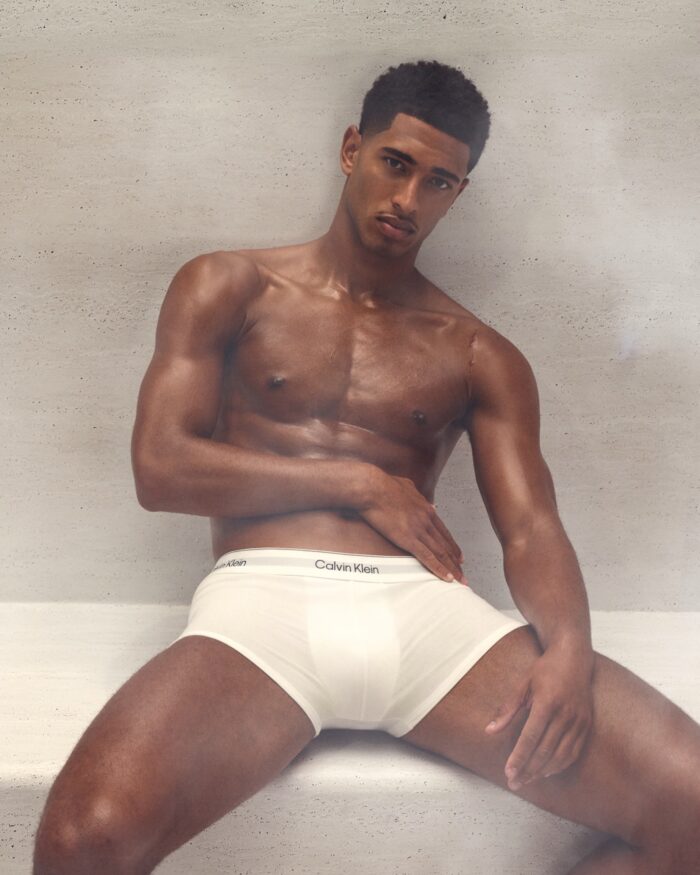
When a massive, faceless billboard featuring nothing more than a sculpted torso appeared in New York City’s SoHo neighborhood in late October 2026, football fans and fashion watchers alike immediately started playing a guessing game. Days later, on November 2, Calvin Klein ended the suspense: Real Madrid and England superstar Jude Bellingham was the new face of its global Icon Cotton Stretch campaign, “The Icon Underneath.”
At just 23, Bellingham has effortlessly joined a lineage of male cultural icons—from Mark Wahlberg to Jeremy Allen White and Bad Bunny—while extending a more than two-decade love affair between Calvin Klein and the world’s biggest football stars.
Inside Jude Bellingham’s “The Icon Underneath”
Shot and directed in Madrid in August 2026 by British photographer Oliver Hadlee Pearch, Bellingham’s campaign blends classic, minimalist studio aesthetics with subtle nods to his day job. Alongside sharp monochrome portraits modeling five silhouettes from the cotton-elastane collection—including a limited-edition metallic-waistband Shine Trunk—the visuals incorporate a playful reference to his signature open-armed goal celebration.
While Bellingham was no stranger to fashion campaigns, having previously modeled for Kim Kardashian’s SKIMS Mens line ahead of Euro 2024, his Calvin Klein debut became an instant internet phenomenon:
- Viral Velocity: The campaign racked up 14 million views on TikTok within its first week alone, with fans jokingly dubbing the reveal Calvin Klein’s “apology” after People magazine named actor Noah Wyle its 2026 Sexiest Man Alive.
- Dressing Room Banter: Inevitably, Bellingham’s Real Madrid colleagues refused to let the moment pass without comment. Former midfielder Toni Kroos left a viral “WTF” beneath the Instagram announcement, while Brazilian defender Éder Militão chimed in with, “Are you crazy? You cannot do that.”
The Blueprint: Freddie Ljungberg and the 2000s Pioneers
Bellingham may represent football’s modern crossover era, but the playbook he is following was written more than twenty years ago in North London.
In 2003, Calvin Klein signed Arsenal and Sweden winger Freddie Ljungberg at the height of the Gunners’ Invincibles era. Running through 2007, Ljungberg’s campaign became one of the most commercially successful in the brand’s history. Long before David Beckham’s famous Emporio Armani billboards or Cristiano Ronaldo’s CR7 line, Ljungberg proved that footballers possessed the athletic physique and global commercial pull to rival Hollywood actors and supermodels.
Three years after Ljungberg’s run ended, Calvin Klein returned to the pitch in 2010, recruiting retired Japanese midfield icon Hidetoshi Nakata—widely regarded as Asian football’s original style trailblazer—to star alongside actors Kellan Lutz and Mehcad Brooks for the global Calvin Klein X launch.
The “Calvins or Nothing” Era: Football Takes Over
After a quieter decade on the football front, Calvin Klein went all-in on the sport ahead of the 2022 World Cup. Launching its acclaimed black-and-white portrait series “Calvins or Nothing”—photographed by Alasdair McLellan—the brand assembled a powerhouse roster of international talent:
- The 2022 World Cup Class: Premier League standouts Virgil van Dijk, Kai Havertz, Richarlison, and Antonee Robinson all stripped down for the Fall/Winter ensemble, while Romelu Lukaku fronted his own solo installment and Son Heung-min became the face of Calvin Klein Underwear in South Korea.
- Spotlight on the Women’s Game: Ahead of the 2023 Women’s World Cup, the brand expanded the series to celebrate women’s football, spotlighting USWNT icon Alex Morgan and England Euro-winning hero Chloe Kelly.
- The Madrid Connection: Among the 2022 alumni was Trent Alexander-Arnold, who returned for a high-profile solo Autumn 2025 campaign—just before making his own blockbuster move to Real Madrid to link up with Bellingham.
Why Football and Calvin Klein Work
Unlike bespoke tailoring houses that rely on red-carpet formality, Calvin Klein’s brand identity has always been rooted in athleticism, clean lines, and understated confidence. Modern footballers—possessing elite conditioning, global social media reach, and massive crossover appeal across music, fashion, and lifestyle—fit the mold better than almost any other celebrity demographic.
From Freddie Ljungberg’s early-2000s billboards to Jude Bellingham’s SoHo takeover, the formula remains remarkably simple: put the world’s best footballers in minimalist monochrome, and let the internet do the rest.


Leave a Reply