While claim frequencies and insurance costs often dominate the conversation around road safety, a new report from its4women has pulled back the curtain on the literal “driving force” behind road risk: speeding.
By analysing thousands of data points from telematics (black box) technology, the report identifies a significant speeding spectrum across the 26 counties, revealing exactly where Irish drivers are most likely to trigger dangerous speeding alerts and where they are most disciplined.
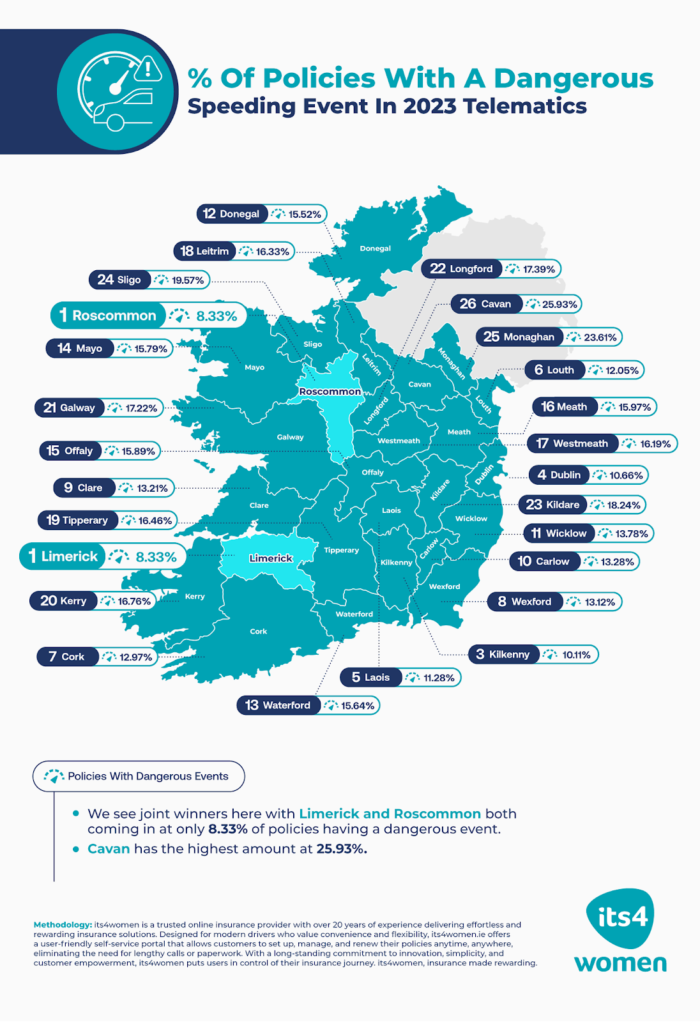
The Speeding Leaderboard: Best vs. Worst
| County | Dangerous Speeding Alerts |
| Limerick | 8.33% (Best) |
| Roscommon | 8.33% (Best) |
| Kilkenny | 10.11% |
| Dublin | 10.66% |
| Cavan | 25.93% (Worst) |
The report’s “Measured By Speeding Alerts” data highlights a stark divide in how Irish motorists handle the accelerator:
- The Safety Leaders: Limerick and Roscommon are tied as the most speed-conscious counties in Ireland. Only 8.33% of telematics users in these regions triggered a “Dangerous Speeding” alert, the lowest rate in the country.
- The High-Risk Zone: Cavan emerged as the speeding capital of Ireland. Over a quarter (25.93%) of drivers in the county triggered dangerous speeding events.
While Cavan leads for dangerous extremes, Monaghan emerged as the nation’s ‘severe speeding’ capital, recording the highest frequency of both severe (37%) and moderate (32%) alerts. This suggests a unique regional trend where drivers are more likely to be consistent over-speeders, frequently pushing the limit rather than doubling it.
The Impact of Technology on Safety
The data suggests that telematics technology is playing a pivotal role in fostering safer driving habits, with drivers using these devices maintaining a better claim frequency in 11 of the 26 counties. This shift aligns with shifting consumer priorities; while general queries for ‘car insurance Ireland’ rose by 20%, searches for ‘how to lower car insurance’ have skyrocketed by 250%.
This surge suggests that Irish motorists are increasingly seeking ways to reduce costs, a goal supported by the its4women findings in Limerick, where the claim frequency dropped significantly from 4% for non-telematics drivers to just below 1% for those utilising safety-tracking technology.
Gary McClarty, CEO of its4women, says:
“Telematics (black boxes) are no longer just a tool for monitoring; it’s a powerful incentive for behavioural change on Irish roads. Our data highlights a staggering ‘safety surge,’ particularly in counties like Limerick, where the use of a telematics box helped slash claim frequencies to a record low of less than 1%.
“This technology bridges the gap between perceived safety and actual road performance by providing real-time feedback that eliminates ‘speed creeping’ and rewards smooth, consistent driving.”
Claim Frequency By Region For Standard Policy Holders:
County Clare has emerged as the safest location in Ireland for drivers on standard insurance policies (non-black box), with a low claim frequency of just 3%, versus the national average of 5%. Following closely behind are Dublin at 3.7% and Waterford at 3.9%, rounding out the top three safest driving counties. In contrast, the data identifies Longford as having the highest claim frequency in this category at 7%. Other counties facing higher claim rates include Donegal (6.64%) and Westmeath (6.29%).
Behavioural Insights
County Carlow drivers proved to be the most compliant when it comes to road legality and motoring offences. Only 3% of policies in Carlow reported one or more motoring offences. They are followed by drivers in Louth (3.24%) and Monaghan (3.53%). In contrast, Tipperary recorded the highest percentage of motoring offences at 7%.
The report also identifies significant regional variations in speeding behaviour amongst telematics users. Whilst Roscommon tied with Limerick for the lowest rate of dangerous speeding events (8.33%), Monaghan drivers were most likely to trigger moderate (32%) and severe (37%) speeding alerts.
Cavan recorded the highest rate of dangerous speeding events at 25.93%.
McClarty continues: “At its4women, we are committed to empowering drivers with their car insurance. By transforming the driving experience from a passive daily task into an active commitment to safety we hope to protect road users, minimise claims and keep excess speeds to a minimum.”
Gary also gives 4 tips on how to be an excellent driver whilst using a telematics box:
1. Early Easing & Gentle Stops
Scan the road ahead to avoid sudden stopping when you lift your foot off the accelerator early rather than slamming the brakes at the last second.
How it Scores: Telematics systems measure deceleration force. By spreading your braking over a longer distance, you keep your “G-force” readings low, avoiding the “Harsh Braking” red flags that significantly tank scores.
2. Build a “Buffer Zone”
Don’t hug the bumper of the car in front. Leave a bigger gap, at least three seconds, so you have plenty of space to react if they do something you weren’t anticipating.
How it Scores: The box can’t “see” other cars, but it can feel when you’re forced to react to them. A big gap means you can slow down gently instead of panic-braking. It keeps your driving data looking like a smooth wave.
3. Lock in Your Speed
Treat the speed limit as the absolute max, not a suggestion. Using cruise control on clear roads can help maintain your speed without it accidentally creeping up.
How it Scores: The box uses GPS to check your speed against the actual limit of the road you’re on. Staying within the speed limit shows the insurer you’re a disciplined driver, which is the fastest way to get a top-tier rating.
4. Avoid the “Danger Zone” Hours
Try to avoid the road between 11:00 PM and 5:00 AM. If you have a few things to do, try to get them all done in one go during the day rather than taking five separate short trips.
How it Scores: This is all about “Risk Factor.” Statistics show that most young driver accidents happen late at night. By driving during “social hours,” the app automatically views you as a lower risk, which keeps your points high without you even trying.
