
Everybody has played a game once in their life. Be it a board game, video game or a simple app on your mobile phone. It’s a way to hang back and relax, to show who’s the best or to immerse yourself in something deep and intriguing. Of course I’m referring to video games at the last option. Video games have been around since the 70’s/80’s and evolved at a tremendous rate. Although I did not jump in until the N64, I did some background research on the times before that just because I love following the industry besides getting my shot playing games. In this part, we will have a look at the late 90s up until the contemporary generation of consoles.
Looking back we can see many developments: from the beginnings of successful 3D with, amongst others, GoldenEye to the transition of shooter games to the consoles with Halo CE. We see players leaving (Sega with their fantastic, yet commercially unsuccessful Dreamcast) and entering the market (Microsoft with their Xbox). This year is a special one indeed when it comes to new entrants: we’ve got at least 6 possible competitors (maybe more, but I believe only 6 have somewhat of a chance to be successful). We’ll come back to them later in part II when discussing the contemporaries and possible future of the industry.
Personal beginnings
So where should we start? As I said, I’m not an old nut from the days of the arcade halls, so let’s have a look at when I actually started playing video games. Because of that, my account of “the history of video games” will start around my fifth year of circling around the sun, when I received Pokemon Red after much nagging to my parents. Pokemon came and immediately became a commercial success. In 2009 IGN even proclaimed Red and Blue to be the “Best selling RPG’s of all time”. It defined a commercial formula that is still being copied to this day: to collect all animals there are to collect. You gotta catch ‘em all, it’s as simple as that. On top of that, Pokemon came with fun trading aspects that made it a favourite on elementary school playgrounds. Almost everyone was busy training their favourites. And even to this day new versions come out, with a lot of nostalgic, older gamers still hooked to the many regions Pokemon has to offer.
A lot of critics argue that the formula has not been renewed enough over the years and that they’re just draining money from the franchise now. Be that as it may, the fact that older gamers and new kids still enjoy catching animals yelping weird, digital noises says something. Pokemon is fun and will probably stay fun for a long time. But they have to come up with something new for the names of their games, though. Pokemon X and Y sound more like new mathematical games with Pokemon in them.
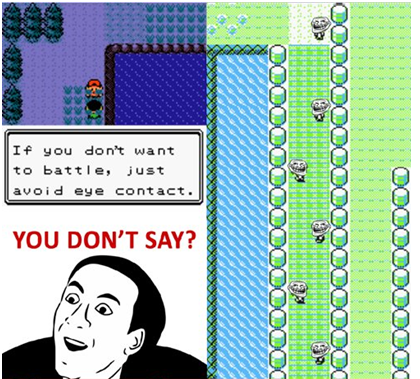
Yep, we’ve all been there..
So what was happening in the meantime while I was busy training my aquatic tortoise to the maximum level? Well, we had some other handhelds besides the Game Boy as well, but I want to take a look at the consoles. Particularly the first Playstation, the Sega Saturn and the Nintendo 64. Two of these three systems ultimately found his way into my home, with the Playstation being the most wanted console in a household of three kids. (My brother, my sister and me) The N64 was actually of my own, while I did not even have the slightest clue of the existence of a Sega console back then. 64-bits was the newest power term being shouted around the market, emulators came on the rise and the earlier mentioned 3D gaming finally started to become casual.
Games like Super Mario 64 (God, I love that game), GoldenEye and Mario Kart 64 showed us what good 3D had to offer and there was a lot more in store for us. GoldenEye was especially significant, since it made the transition from standardized Doom clones to varied First Person Shooter games, including stealth elements, mission objectives and more. Fun fact: Did you know Tomb Raider, another revolutionary game, was first released on the Sega Saturn? Kind of blew my mind. All in all, it were dynamic times for video games, with the transition to CD-based video games and the loss of two very classic and earlier influential hardware makers: Sega and Atari. The console wars of the 90s were rough and made clear that the video game industry was not that easily dominated. A lot of historical favourite games were spawned, such as Gran Turismo, Metal Gear Solid, Tomb Raider, Resident Evil and a lot, lot more.
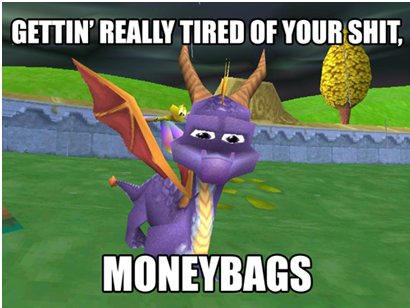
If you get this meme, I will shake your hand. Best. Game. Ever.
The Fall of Sega and the Rise of the PS2
I could go on and on for many more words about this particular time, but let’s move on a bit. What came after generation five? Right! Generation six. It was the first generation where I became somewhat aware of the existence of a video game market and it was the first generation where I actually bought my console myself, being Microsoft’s first attempt to conquer the console market: the Xbox. My sister bought a PS2 as well, while once again Sega’s console was nowhere to be found. Which is a shame really, because I highly enjoyed a Sega game that started on the Dreamcast: Jet Set Radio.
It was actually a revolutionary console in many ways. But because of their financially dire straits position, combined with a lack of third-party developer content and many DRM cracks on the Dreamcast, Sega had to wave the hardware market goodbye in 2001 in the Western world. I explicitly say the Western world, because the console apparently went on until 2007 in Japan. On top of that the PS2 lured many consumers back to Sony. But when looking back we can see a couple of things this magnificent machine revolutionized and left behind in current generations. Guess what: they actually started online networks! Via SegaNet, their dedicated server, you could browse and play games online. It is indeed the precursor to our beloved Xbox Live and PlayStation Network. Other firsts were the first game with in-game voice chat, the first online multiplayer console game, among the first downloadable contents, the first virtual pet games and the popularization of cel-shaded graphics.
Considering all that, the Dreamcast did not deserve the fate they met, but on the other hand the other three consoles were not simply luring consumers without reason. The PS2 became the dominant leader, with Sony effectively ending their support for the console in January 2013 (!). One of the main reasons is plain and simple, and one of the most important reasons hardware makers sometimes forget: gamers just want games! They want to play more than just a few characteristic and iconic video games. With over 3850 video games available up until today, the PS2 did just that. Another very smart move hardware producers sometimes forget was the fact that the PS2 was fully backwards compatible (Learn from that Microsoft..).
PS1 games could still be played and since the transition to a new console costs money, which is the same with new games, backwards compatibility gave the gamer a feeling to be able to play more than the first launch titles. Furthermore, the built-in functionality to play DVD’s also attracted consumers who wanted more than to play video games or vice versa. Lastly, the temporary exclusive support from franchises such as Grand Theft Auto kept the momentum they needed when Microsoft and Nintendo stepped in with their Xbox and Gamecube. Personally I never had that much with the Gamecube. The controller annoyed me, and the lack of big hardcore games like Halo or GTA did not cut it for me. I could not think of many revolutions they sparked as well. Do correct me with a ranting, little comment if I’m wrong.

Yep, it’s been that long. Amazing isn’t it?
A new entrant: the Xbox and his ginormous Duke controller
On the other hand, the Xbox did come with a new, big surprise: the evolution of online console gaming. With Xbox Live they set up a strong online gaming network, evolving further than SegaNet and easily beating PlayStation’s early online networks on the PS2. Their processing power was bigger than that of the PS2 and Gamecube, but that could not overcome Sony’s dominance by reasons already stated. They did however beat Nintendo’s Gamecube with sales. Considering this was Microsoft’s first serious entry into the market that could be called pretty impressive: establishing a loyal community with their online play, starting a new iconic franchise (Halo) and beating a brand that had been around for many, many years (Nintendo). And indeed, I was part of this new community. I thoroughly enjoyed LAN-play with Halo CE and Halo 2, yet I was just a bit too young to understand how to hook up to Xbox Live. The controller might have been a bit big at first, but hey, everyone needs to learn in at the start, right?
Reading all of this, gamers might wonder that I’m forgetting something. That’s right! I did not mention handheld gaming yet. But for now this will be the end of part I, since there is still a lot, lot more to discuss. In part II we will continue with a look at the handheld market, the seventh generation and a look into the future of generation eighth. Maybe there will even be a part III. Maybe not. Do let me know if you enjoyed this article and as I said at the very small fragment on the Gamecube, feel free to comment on issues I forgot or wrongly addressed.
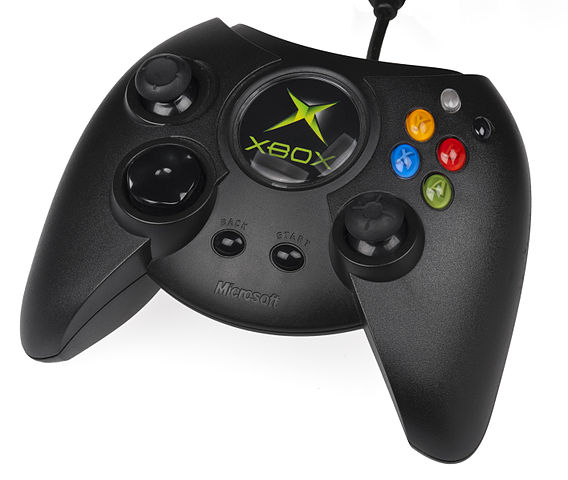
The infamous Duke controller. I still own one.
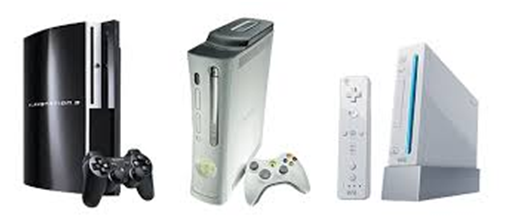
Guess what? They’re up next.
