At the dailywaffle towers, there’s a lot of internal banter. The latest….
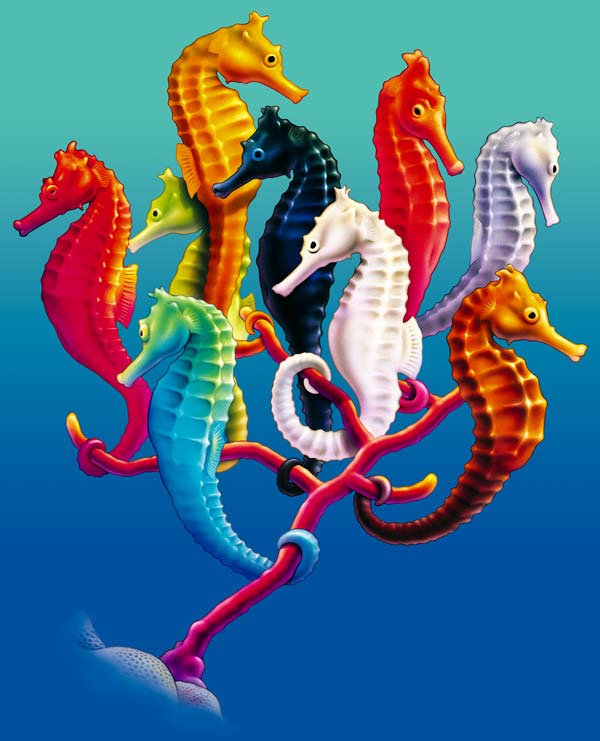
Let’s hear it for the seahorses. So this article is for John 😀
I adore seahorses, their look, their life style….. They are so cute! But unfortunately population to date of the worlds 35 species is sparse 🙁 Also worldwide coastal depletion, pollution and rampant harvesting mainly used in Asian traditional medicine, has made several species vulnerable to extinction.
So what are seahorses?
Seahorses are actually fish. They look like mini horses with curly tails for gripping to seagrasses and coral. Ranging from 1.5-35cms long you will find them swimming about in shallow tropical and temperate waters around the world. On that note, they actually aren’t that good at swimming. They can easily get exhausted and die if caught in storm rolled seas. Thus that prehensile tail that grips on tight during adverse conditions. They propel themselves by using a small fin on their back that flutters up to 35times per second 🙂 and smaller pectoral fins at the back of their heads are used like rudders to aid steering. They eat plankton and small crustraceans sucking it up their elongated snouts. They can consume 3,000 or more brine shrimp/day.
Seahorses graze all day 🙂 This is because they have no stomachs so food passes thru the digestive system so quickly they eat almost constantly to stay alive. Seahorses also have independant eyes, a bit like a chameleon, and during social moments or in unusual surroundings, seahorses turn bright colours. They live 1-5years in the wild, though captive bred seahorses survive better and in recent years have become popular with many aquarium hobbyists.
The fascinating thing about seahorses is unlike other fish, they are monogamous and mate for life. Rarer still, they are among the only animal species on Earth in which the male bears the unborn young. WOW! Male seahorses are equipped with a brood pouch at the front. During mating, the female deposits her eggs in his pouch and he fertilises them internally. They stay there until they hatch, then fully formed miniature seahorse are released into the water. Awh 🙂

Scientific Classification
Kingdom. Animalia
Phylum. Chordata
Class. Actinopterygii
Subclass. Neoterygii
Infraclass Teleostei
Order. Syngnathiformes
Family. Syngnathadae
Subfamily. Hippocampinae
Genus. Hippocampus
So there you go 🙂
seahorses are pretty cool 😀
For more information
www.theseahorsetrust.org
www.nationalgeographic.com
www.seahorse.org

Love it, Kay 🙂