With the cold snap well and truly settling in here in the UK, it’s no surprise that there’s once again talk of snow being on its way. Snow, ice and sleet make driving at best, difficult and at worst, fatal. Winter tyres are designed to make driving in such conditions safer for drivers, and work best when the temperature falls below 7 degrees centigrade.

Photo Credits– For many drivers from late November to February this is a common scene on the commute to work
That’s not to say that winter tyres can’t be used all year round, it just means they perform better at lower temperatures compared to standard tyres, and will wear out quicker if used in dry weather. Even on wet surfaces, winter tyres are beneficial to drivers, and with the amount of rainfall in the UK, maybe it’s time drivers stopped seeing winter tyres as something just for the festive period.
Winter tyres provide safety when driving, which is a priority for all drivers
With the statistic that drivers are six times more likely to have an accident during the winter, adding ice, snow and sleet to that mix increases the risk further, so safety for driving during such precarious conditions is vital.

Photo Credits– Skidding on snow can be reduced by applying winter tyres
Winter tyres provide grip, which can’t be paralleled by standard tyres. A car travelling at 30mph on snow will stop at 35 metres, if fitted with winter tyres, but with standard tyres the stopping distance is increased to 43 metres.
The reason why there is such a difference between the stopping distances for the two sets of tyres is because of the silica compound, which is used to make winter tyres, enabling the tyres to remain flexible in the coldest of temperatures.
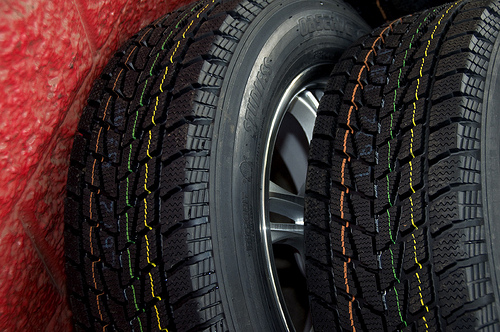
Photo Credits– As you can see these winter tyres are studded and provide a lot more grip than standard tyres
The rubber compound is what gives winter tyres their unique ability to keep drivers safe during cold conditions, as the softness of the rubber still remains,even at the coldest of temperatures, compared to summer tyres, which provide the necessary amount of grip during dry conditions, but become hard when the temperature drops to anything below 7 degrees centigrade, meaning these tyres aren’t able to maintain their grip.
Whilst it’s worth pointing out that winter tyres can be used in damp and wet conditions, it’s not the best idea to continue using them after the cold spell’s gone, as the dry weather will wear out the rubber in more mild temperatures, resulting in the tyres losing the ability to grip ice and other wintry surfaces.
A long-term investment for a product with longevity
Although changing tyres twice a year may seem like it’s throwing money away, the rewards for drivers outweigh the financial aspect. In fact, in the long term for drivers, investing in a pair of winter tyres for the coldest part of the year will ensure that standard tyres don’t get worn out, minimising the risk of having to replace them more frequently. Having a set of tyres for the colder months, and a set of tyres for the rest of the year means driversimprove the safety of their vehicle, whilst also making a sound financial investment when it comes to not having to fork out to replace a set of worn out tyres that have been used for every month of the year, whatever the weather.
About the Author
This article was written on behalf of LK Performance, who are a leading alloy and tyre wheel specialist. Make sure you stock up on your winter tyres while stock lasts or you may find the roads potentially more dangerous than they can be in the colder weather.
