As a parent it’s important to lead by example and educate your children about sustainability from the offset. But what is the best way to teach your children about sustainability?
Businesswaste.co.uk share their top tips for how to teach children about sustainability in order to help protect our planet for generations to come:
1. Share clothes
When your children outgrow their clothes don’t just throw away or push to the back of the wardrobe but explain to your children that someone else is going to love their clothes and pass it on to their siblings or friends. Recycling outgrown and unwanted clothes will help to avoid buying more items.
2. Make recipes with leftover food
There’s nothing that’s more shameful that throwing food away, all because we’ve cooked or bought too much. As a nation we throw away more than 4.5 million tonnes of food each year1 and so its important that we all do our bit to reuse leftovers. From making soups and pies there are plenty of recipes out there and get your children involved in cooking a fun meal together with the leftover ingredients.
3. Walk to places where possible
Teach your children that its important to walk to places instead of jumping in the passenger seat. From walking to school and to the local shop, public health research shows that children who do some form of exercise, especially a walk, before school do better in class2. Not to mention the positive effects such as lowering emissions.
4. Get crafty
From the bottles, jars and boxes that quicky fill up the recycling bin can offer hours of fun for kid’s craft projects. Milk carton bird feeder to homemade musical instruments are some of the many things you can make with the recycling and the best part of getting crafty is that it offers a fun lesson in sustainability.
5. Have fun in the garden
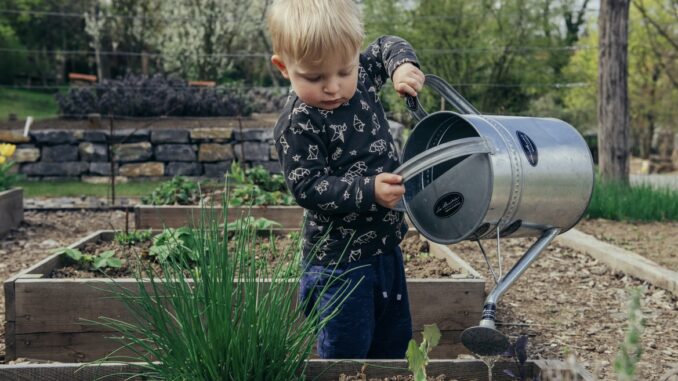
Another great way for teaching your children about sustainability is to spend time in the garden. By having the fulfilment of growing your own fruit and vegetables and using your food waste to make compost. Gardening will teach your children to love recycling since they will be able to see and enjoy the benefits.
Sources:
- https://www.theguardian.com/environment/2020/jan/24/uk-households-waste-45m-tonnes-of-food-each-year
- https://www.pathsforall.org.uk/wod-tip-and-story/why-walking-to-school-is-so-important
Thanks for reading this article on how to teach your children about sustainability.

This is great as we need to teach young people to be sustainable.
These are excellent ideas!
My nephew loves a good walk, and he loves helping to sort the recycling.
We have a box filled of “junk” for him to use for crafting but haven’t introduced him to it yet. I know he’ll love it.
Cora | https://www.teapartyprincess.co.uk/
Love this! I love how they want to get involved from a younger age – just wish we were making their future better!
Thanks for sharing this. What I like about these ideas is that they are all simple and easy to put into practice. In fact, many of them are things our family used to do when I was a child long before sustainability became a hot topic.
Yeah, definitely! Thanks for reading.
Great tips.
A lot of cartoons we watch recently have a song about recycling and sustainability and I’m happy to see it.
I know nursery also teach the little ones about this.
I will save and use your tips next time we are doing activities for family time.
Yes!!!!!! These are good ways to train kids to be sustainable. I shall share this with some of my friends who have kids. Thank you for sharing.
Amazing list. We grow lots of veg and my husband just built our new shed from old decking. Hate wasting stuff … also just brought my wedding dress secondhand
I love having a veggie plot! Always gives me such satisfaction 🙂 Congrats on the wedding too – lovely!
Brilliant ideas here, it’s vital that we teach our children about recycling and sustainability. Thank you so much for sharing
Just like children aren’t to young to learn about racism and mental health, they’re also not to young to learn about sustainability
We do most of these with the kids I nanny, but the food is one of those they are just not willing to shift from, sadly. They will not re-eat the same thing the following night, but I am able to transform most things and with a twist they will be able to savour it under a different light. A life saver!
It’s great that you have managed to find a way!
These are all practical and helpful tips to engage kids to respect the environment from early on.
Thanks for sharing.
Yeah, I think at any age we need helpful and practical tips but especially for kids – they seem so invested and willing to learn too!
These are great ideas. These are things that I grew up doing. Whilst it was more because of lack of money than sustainability at the time, it teaches so many great skills and values.
I think it’s great for kids of today to have these great values.
Thanks for reading!