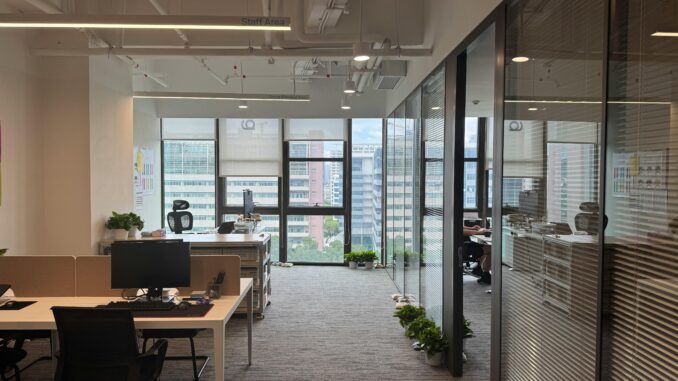
Office workers spend 70% of their time in meetings but offices aren’t designed for it
New research reveals a major mismatch between how employees actually work and how modern offices are designed, with workers now spending the majority of their time collaborating rather than working at desks.
A survey of 196 office-based employees by Diamond Interiors found that staff spend an average of 42% of their time in face-to-face meetings and a further 28% on confidential calls, meaning around 70% of the working day is spent communicating.
Despite this shift, most office environments remain heavily desk-focused, raising questions about whether workplaces are fit for purpose in the era of hybrid working.
The data also shows that 73% of meetings involve just 1 to 4 people, yet many offices continue to prioritise larger meeting rooms and open-plan collaborative areas.
Hannah Prescott of Diamond Interiors said:
“Offices have been designed around desks for decades, but that is no longer how people work day to day.
Our research shows that the majority of time is now spent in conversations, whether that is small meetings or confidential calls, yet many workplaces simply do not have the right types of spaces to support that.”
She continued:
“There is a clear mismatch between behaviour and design. Businesses are investing in large meeting rooms and open-plan areas, but what employees actually need are smaller, more flexible and more private spaces.
If people are spending 70% of their time communicating, the office needs to reflect that, otherwise it is not supporting productivity.”
The findings also point to a growing demand for privacy in the workplace. Open-plan environments and informal collaboration spaces performed significantly worse than enclosed meeting rooms, suggesting employees are increasingly uncomfortable holding conversations in open settings.
Hannah Prescott added:
“We are seeing a real shift away from the idea that open-plan equals collaboration. In reality, people want spaces where they can focus, speak freely and not feel overheard.
Designing for privacy, comfort and flexibility is becoming far more important than simply maximising desk space.”
The research forms part of a wider workplace study exploring how office design can better support modern working patterns, particularly as organisations continue to adapt to hybrid models.
Photo by Eric WANG: https://www.pexels.com/photo/modern-open-space-office-with-large-windows-28715052/
