One year after landmark legislation required all UK businesses to separate dry recyclables and food waste, new research from commercial waste experts Direct365 reveals that a lack of national standards is turning business recycling into a fragmented landscape.
The study analysed Freedom of Information data from 190 UK councils and found that while Simpler Recycling rules changed in March 2025, businesses are still struggling to dispose of waste seamlessly.
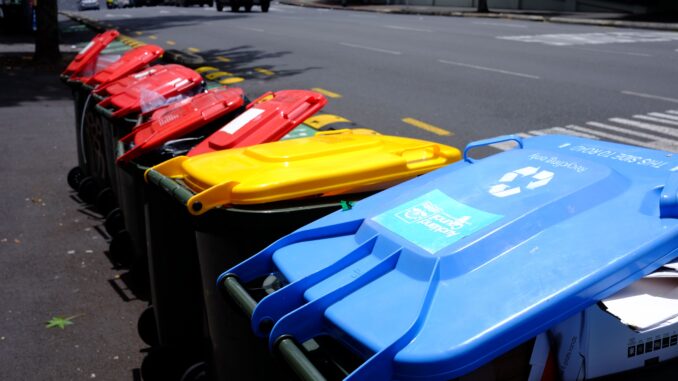
The primary barrier is the lack of a universal standard for bin colours, with the research identifying at least 80 unique bin colour combinations currently in use across the country. The lack of standardisation means a business owner with multiple sites could be recycling correctly in one town but using the incorrect bin just five miles away.
The UK councils issuing the most formal waste warnings*
Despite the 2025 legislation granting local authorities the power to issue Fixed Penalty Notices for waste offences, the vast majority of the UK is currently operating without formal enforcement. The data collected reveals that despite businesses struggling to meet the new requirements, 90.5% of councils have issued zero formal warnings or fines in the last twelve months.
In the absence of a unified national approach, enforcement remains highly localised, with only a handful of proactive councils currently issuing fixed penalty notices.
- Cardiff: 786 formal warnings
- Durham: 322 formal warnings
- Doncaster: 273 formal warnings
- Hammersmith & Fulham: 203 formal warnings
- Reading: 171 formal warnings
Fines issued between 1st April 2025 – 31st March 2026*
Cardiff has been identified as the UK’s primary enforcement capital. The council issued 786 formal warnings last year meaning that it has issued more fines than the rest of the top five hubs combined and stands in stark contrast to the 172 councils that issued none at all.
The UK councils with the highest waste rejection rates (% of total tonnage sent to landfill)
- Barking & Dagenham – 39%
- Newham – 37%
- Bradford – 30%
- Nottinghamshire – 25%
- Mid Devon – 25%
Commercial waste collections rejected between 1st April 2025 – 31st March 2026*
Barking & Dagenham recorded the highest waste rejection rate in the country at 39%, meaning that for every five tonnes of business recycling collected by the council, nearly two tonnes are deemed too contaminated to process.
Newham followed closely with a 37% rejection rate. This indicates that more than one third of all business waste collected for recycling in the borough was diverted to landfill in the past year.
Bradford recorded the third-highest rejection rate in the study at 30%. Despite being one of the largest commercial waste hubs in the country, nearly one-third of all collected refuse in the city still fails to meet the required quality standards for recycling.
The UK councils where business waste rejection is worsening (% increase in rejection rate*)
- Gravesham – 350% increase
- Newham – 188% increase
- Highland – 130% increase
- Cambridgeshire – 38% increase
- Barnsley – 33% increase
% increase in commercial waste collections rejected between 2024/2025 to 2025/2026*
Gravesham saw the UK’s most significant deterioration in commercial waste rejection over the past year. The council saw rejection rise by 350% over a 12-month period, marking the largest increase in failed waste tonnage identified in the study.
Newham followed with an 188% surge in rejected waste, while Highland Council came in third position, reporting a 130% spike in rejection since the ‘Simpler Recycling’ legislation was introduced last year.
The UK councils where business waste rejection is improving (% decrease in rejection rate*)
- Brighton and Hove – 43% decrease
- Rotherham – 33% decrease
- Stoke-on-Trent – 32% decrease
- Mid Devon – 17% decrease
- Bradford – 14% decrease
% increase in commercial waste collections rejected between 2024/2025 to 2025/2026*
Several local authorities have proven that contamination can be successfully managed. Brighton and Hove recorded the UK’s most impressive improvement, cutting its rejection rate by 43% since the introduction of new legislation last year.
Rotherham and Stoke-on-Trent also achieved significant reduction rates, seeing failure rates drop by 33.3% and 31.8% respectively.
Karl Bantleman at Direct365 commented: “While the transition to new recycling legislation is a positive step, our data shows that fragmented bin colours are turning waste separation into a visual guessing game. With at least 80 different bin colour combinations identified across the country, businesses face a complex challenge in their efforts to stay compliant.
“While it is encouraging to see many local authorities prioritising education over enforcement, the rise in bin refusals suggests that businesses need more clarity to help them stay compliant and exemplifies the real opportunity for greater standardisation across the country.
“To help ensure waste is correctly separated and avoid the risk of uncollected bins or a fine, businesses must provide clear signage for all waste streams, deliver regular recycling training for staff, and most importantly, conduct waste audits to identify contamination before collection.”
Photo by Thomas: https://www.pexels.com/photo/vibrant-recycling-bins-on-auckland-street-36002401/
