The debate rages every time a group of friends or family indulge in Indian, Pakistani or Mexican cuisine – how hot do you like it? The common compromise of medium spice with a little piquant present seldom satisfies the fiery desire of heat lovers and often leaves the mild members with red eyes and runny noses.
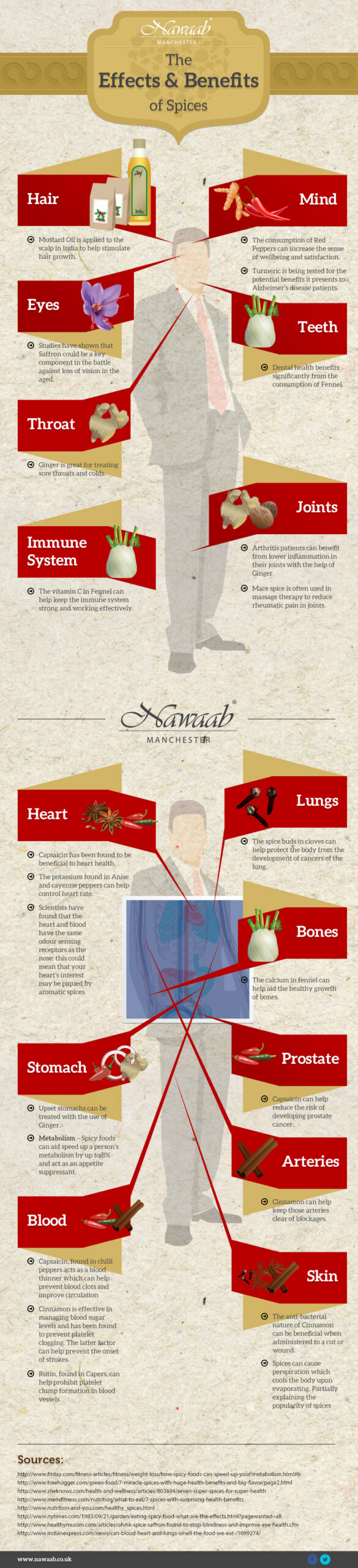
However, the spice lovers do have an advantage in their argument – the incredible array of health benefits present in spices and peppers. From hair to heart, the spices traditionally found in Indian dishes can aide a person in a multitude of ways.
Capsaicin is the active component of chili peppers and is something of a one-stop vital organ doctor – helping regulate blood circulation and prevent clotting whilst also serving as a defence against the development of prostate cancer and proving beneficial to heart health.
The heart in particular seems particularly fond of spicy foods and aromas – researchers have discovered that the heart and blood and the exact same odour sensing receptors as the nose. This suggests that your heart may be piqued by the smell of aromatic spices.
For generations parents have tried to increase their children’s intake of milk to ensure that the calcium rich drink provides sufficient calcium for healthy bone development. Fortunately, fennel – found in many aromatic vegetable dishes and Indian dips – is also an excellent source of calcium, helping your children grow up to be big and strong.
Indian takeaways are often criticised for their high levels of oil and high fat content, leading to a suggested nation of overweight binge eaters – but spicy foods can both act as a trigger to speed up a person’s metabolism by upwards of 8% and also acts as a very helpful appetite suppressant. The latter is particularly helpful for those who are prone to late-night snack temptation.
For those who are used to using cinnamon as simple sprinkling on their morning coffee may be surprised to hear that it makes an appearance in a number of creamy and sweet curry dishes. The subtle sweetness of cinnamon means that this is one spice that spicy food-haters can indulge in and reap the health benefits such as effective blood sugar management, arteries clearing. Furthermore, cinnamon is anti-bacterial and can be used to clean a wound.
Owner and manager of one of England’s most famous Indian Restaurants, Nawaab Manchester, Asad Malik believes that the health benefits are just one of the reasons why Indian cuisine is the nation’s favourite: “I don’t believe that people eat Indian food just for reasons of health, but we feel great that we include ingredients in our menu that can help people live a long and healthy life.”
As well as keeping you fit and healthy, it has been discovered that consuming red peppers can help lead to an increased sense of wellbeing and satisfaction.
It is not just mental and physical benefits that can be derived from the use of spices. Superficial improvements can also be made – mustard oil has long been attributed to virility in India and is applied to the scalp to simulate hair growth.
Whilst this may not be enough to convince those who suffer from burning tongues every time a pepper passes their lips, it can certainly give spice lovers a sense of smug satisfaction.