For some, sleep is simple, as they fall into deep slumber the moment their heads hit the pillow. For others, it is more elusive.
We sit somewhere in between, but we definitely know the pain of seeing sunlight peek round the curtains after a night spent tossing and turning. This is why we can easily appreciate the many superstitions that have sprung up around bedrooms, bedtimes and, of course, sleeping habits in an attempt to help limit these sleepless nights.
Unbeatable Blinds, a British soft furnishing company, always aim to help their customers find a peaceful slumber in a darkened room. They thought they’d explore the origins of weird and wonderful bedroom superstitions to see if they could spot any tips or tricks that could help us find a surefire way for a deeper sleep.
We’re not sure that they’ve discovered the secret to a restful night, but they have highlighted the interesting origins of bedroom superstitions stretching all the way back to the ancient Egyptians and Romans.
Don’t Leave Indentations in Your Bed
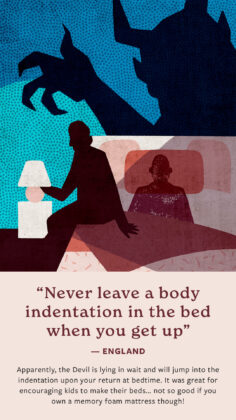
In days gone by, mattresses were stuffed with straw and feathers. Not quite achieving the comfort or luxury of memory foam, these early mattresses also lacked the “bounceback” of pocket springs. Most mornings, when you dragged yourself out of bed, you left an imprint on the surface of the mattress showing exactly where you’d lain.
Rather than saving this shape ready to curl back up the next night, the British saw these indents as an invitation for evil. They believed that you must smooth out and reshape the surface, otherwise, you’d return to find the devil literally laying in wait for you.
It’s hard to tell where this superstition started, but it was picked up by parents in England as a way to convince their kids to make the bed every day. Well, we say convince but ‘terrify their children into doing their chores’ is probably more accurate.
Never Leave a Hat on the Bed

The Italian superstition of never leaving a hat on your bed might seem completely random but it has a few possible roots.
According to historian Neal Katyal, one possible origin has distinct religious ties. When performing the Catholic tradition of last rites for a dying person, priests would remove their hats as a mark of respect. Thus the sight of a hat discarded on a bed became an omen of terrible things to come.
The other option has a slightly more icky solution. It stems from a belief that evil spirits reside in your hair. When you removed your hat, you took the spirits with it and released them onto the bed.
So far, so fanciful, unless you consider head lice as evil spirits of course. We can definitely class these horrible critters as evil, and can see why people would want to avoid introducing them to a bedspread where they might find a new host.
Never Sleep With Your Head to the North

Though this superstition originates in Japan, it is actually tied to the Buddhist faith and has spread across the world with the religion.
The belief that you should never sleep with your head to the north has such a strong history it even has its own name, which translates as ‘north pillow’, though the reasoning behind it is less clear.
Buddhist traditions see people buried with their heads pointing north, the same way Buddha was buried, head pointing north, facing the west. It is seen as a bad idea to sleep in this position, as you are essentially sleeping as a corpse would.
Another possible reason behind the superstition ties it to the magnetic forces of the world, and how it aligns with our own energies.
If You Hear an Owl at Night, Terrible News is Coming
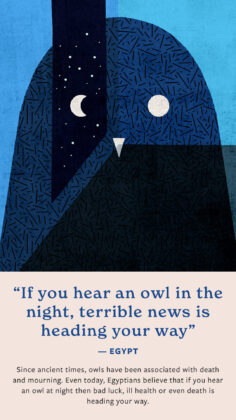
A silent night shattered by an unexpected hoot of an owl is something of a spooky cliche these days. It’s easy to believe it stems from a superstition stretching all the way back to Ancient Egypt.
Ancient Egyptians were not fans of owls at the best of times. Though they are commonly featured in art and religious texts, they were closely associated with mourning and death. They were always depicted face on which was a stark choice compared to other animals and they were thought to be a terrible omen. The name even translates as ‘the one who laments’ putting owls firmly in the ‘too be avoided’ category.
Of course, the sound of one hooting was also a bad omen. In defence of owls, it was believed to be a warning of something terrible is approaching, be that bad luck, illness or even death, but the lack of specifics makes it ultimately unhelpful.
Never Chew Gum After Dark
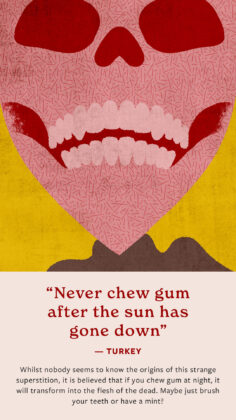
Not quite bedroom-specific, this Turkish superstition is so ghoulish it has to get a mention.
The superstition states that you should never chew gum after the sun has set because it will turn to human flesh in your mouth. Delightful.
The exact origins of this macabre belief can’t be traced and that’s probably a good thing. Still, it’s definitely enough to make us stow away our Wrigleys before sunset, just in case.
Never Leave Your Bedroom Window Open on All Saints’ Day

All Hallows Eve (Halloween) is generally considered the spookiest day of the year, but in Spain it is All Saints’ Day (November 1st) that carries the most superstitions.
The traditions of the day are taken very seriously – it is even a public holiday. The focus of the day’s celebrations is honouring the dead, with many Spainiards using the day to visit the graves of their lost loved ones.
The superstitions around the day arise because it’s thought to be the one day a year where the dead roam freely among the living. With all these marauding spirits around, it is said that if you leave your bedroom window open, then one such lost soul might find its way in and make itself at home.
We’ve seen enough horror films to understand all the havoc a disturbed spirit can wreak so we’ll be keeping our windows, our doors AND our blinds shut – just in case.
Always Sleep With an Axe Under Your Bed
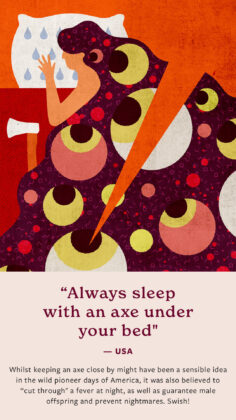
This suggestion came from the wild pioneer days of America, when it probably counted as more of a sensible step than a superstitious one. Afterall, with all the dangerous animals (and people!) roaming the American wilderness, having a source of protection close to hand at all times was probably essential for survival.
Of course, this is a list of superstitions, and the idea of keeping an axe nearby when you slept had a more mystical origin. The axe was alleged to bring good luck, have the ability to “cut through” a fever and even help you have sweet dreams – though perhaps that was just because you could sleep deeper knowing you were protected if a hungry animal rudely woke you.
Always Get Out Of Bed On The Same Side You Got In

How many times have you been accused of getting out of the wrong side of the bed in the morning? For us it sometimes feels like a weekly occurrence, yet never once has anyone ever clarified which side is ‘right’.
The Romans believed that ‘the wrong side’ was whichever side you didn’t get in, but it mainly applied to the left side. Their superstition stated that if you got out on the opposite side to the one you got in, you doomed yourself to a day of ill luck and bad tempers.
Never Sleep on the Ground

Perhaps the spookiest sleep superstition of all started in South Africa, after a series of unexplained deaths.
After a number of people died while sleeping on the floor, the finger of blame pointed towards ‘Tokoloshe demons’. These were evil creatures, said to be created by a witch doctor looking to extract revenge on his enemies. To avoid the Tokoloshe, people refused to sleep on the floor anymore, with some raising their beds to extra heights using bricks to be certain they were out of reach.
We say these deaths were unexplained (apart from murderous Tokoloshe creatures) but modern science puts forward a strong reason for these unfortunate nighttime exits.
In this time, people would commonly sleep all curled and cosy by their campfires to keep themselves from getting cold. Unfortunately, these beds and fires were created in small huts (or rondavels) with not much space and even less air. An open fire in an enclosed space is a surefire way to fill the air with carbon monoxide, a poisonous gas that still kills to this day.
Carbon monoxide has no colour, smell, or taste at all so these unfortunate sleepers would have no way of knowing they were slowly but surely poisoning their blood as they slept.
