The NHS Couch to 5K app turned ten recently. And while that might sound like a niche milestone, for a huge number of people — myself very much included — it represents something far bigger than a free running programme. It represents the first time getting fit felt genuinely achievable.
I first tried Couch to 5K years before I actually finished it. Like a lot of people, I’d start with good intentions, bail somewhere around week three, and file it under “things that are probably just not for me.” Then lockdown happened. Nowhere to go, nothing else to do, and somehow — finally — it stuck. I crossed that metaphorical finish line, wrote about it, and felt a kind of quiet pride I hadn’t expected at all.
Since then I’ve gone back to it a few times. My fitness focus has shifted — Pilates and strength training take up most of my movement time these days — but Couch to 5K is always there when I need it. Here’s why it still holds a special place.
It Did Something Quiet But Significant for My Mental Health
I didn’t start running for my mental health. I started because lockdown had made my world very small and I needed something — anything — to do with my body that wasn’t walking around the same block for the fourth time that week.
What I got alongside the improved fitness was something I hadn’t bargained for: a reliable mood reset. Getting outside, moving, doing something measurably hard — it clears mental noise in a way that very little else does. Not every run felt good. Some felt genuinely awful. But I almost always came back through the door feeling calmer, clearer, and a bit more like myself.
For anyone who deals with anxiety, low mood, or just the particular kind of fog that comes from sitting at a desk all day, running offers something hard to replicate. It’s not a cure for anything. But it’s consistent, it’s free, and it’s available the moment you step outside. Couch to 5K makes that accessible — the graduated structure means you’re never doing more than your body can handle, which means you never have a reason to quit that feels truly justified.
The Feeling of Actually Finishing Something
Can we talk about how underrated it is to just finish something?
Especially exercise. Especially as an adult with a full life and seventeen other things competing for your time. The number of fitness plans, gym memberships, and good intentions that have quietly dissolved in the background of my life is genuinely embarrassing. Couch to 5K was different because it had a clear end point — and reaching it felt like a proper achievement.
The graduation run — the full 30 minutes without stopping — is one of those moments that stays with you. It sounds small from the outside. From the inside, it’s enormous. Because you did something you genuinely didn’t think you could do, one small step at a time.
That feeling of completion is something I actively chase now. It’s part of why I keep returning to the programme. There’s a particular satisfaction in starting at week one, knowing you’ve done it before, and doing it again anyway — like proof that you still can.
What It Means to Call Yourself a Runner
I remember the first time I referred to myself as a runner and immediately wanted to take it back. It felt presumptuous. Surely real runners did marathons? Had GPS watches and gels they ate mid-run? I just jogged around the block a few times a week.
But here’s what Couch to 5K quietly teaches you: if you run, you’re a runner. That’s the whole definition. No minimum pace, no required distance, no entry requirements. You lace up, you go, you come back. You’re a runner.
Owning that identity — even tentatively — changes something. It changes how you treat your body, how you talk about exercise, and how you feel on the days you skip versus the days you go. Identity is powerful, and Couch to 5K hands you one you might not have thought was available to you.
The London Marathon and Why It Makes Me Emotional Every Single Year
I will never run the London Marathon. I want to be absolutely clear about that. I have enormous respect for everyone who does, and zero personal desire to join them.
But every April, without fail, I watch coverage of it and feel something unexpectedly emotional. Not about the elite runners finishing in times that don’t seem humanly possible — though that’s impressive in its own way. It’s the everyone else. The people in fancy dress. The people running for someone they’ve lost. The person who looks like they’re in absolute agony at mile 22 and is going anyway.
There’s something about mass participation running that restores your faith in people just a little bit. All of these ordinary humans who decided to do an extraordinary thing, who trained through dark winter mornings and long Sunday runs, who asked for sponsorship and then had to actually follow through. Couch to 5K is in the DNA of a lot of those marathon runners, I’d imagine — the thing that made them believe, for the first time, that maybe they were someone who ran.
Not me, though. I’ll be cheering from the sofa with a cup of tea.
Ten Years On
In a decade, Couch to 5K has genuinely changed lives — not in a hyperbolic, marketing-speak kind of way, but in a real, get-outside-and-feel-a-bit-better-about-yourself kind of way. For a free programme attached to a free app, that’s a remarkable thing.
My relationship with running has evolved since that first lockdown finish line. I run less than I used to, and my body gets most of its movement from Pilates and strength work these days. But running is still there — still available, still the thing I return to when I need to clear my head or prove something to myself.
If you’ve been thinking about giving Couch to 5K a go, the tenth anniversary feels like as good a reason as any. It’s nine weeks. It’s free. And it might just change how you think about what you’re capable of.
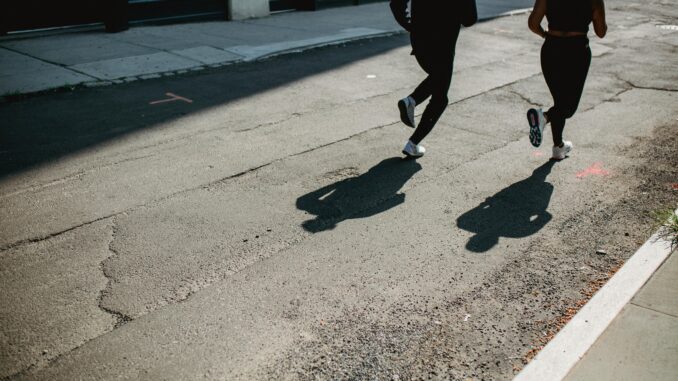
Photo by Ketut Subiyanto: https://www.pexels.com/photo/people-jogging-on-a-city-street-5036843/