Think getting fitter means expensive gyms, punishing routines and hours of hard graft?
Think again.
New research by 101 Great Goals has revealed that the same kinds of exercises England’s biggest football stars use to cope with the pressure, pace and physical demands of elite football can actually be adapted for everyday life at home.
From Harry Kane’s ankle-strength drills to Jude Bellingham’s lower-body power work, many of the movements behind top-level performance are surprisingly simple and need little more than a chair, a wall and a bit of space in the living room.
That means whether you’re a teenager wanting to sharpen up, a parent trying to get back into exercise, or a grandparent looking to stay mobile, there are football-inspired moves you can steal for yourself.
Jon Fisher, football expert at 101 Great Goals, said: “People often assume professional football training is all about high-tech equipment and intense gym sessions, but a huge amount of it comes down to simple, repeatable movements done consistently.
“That’s why so many of these exercises translate so well to everyday fitness. They help with strength, balance, mobility and coordination, which are useful whether you’re playing 90 minutes or just trying to feel fitter and move better.”
Kane’s ankle secrets could help you stay steady on your feet
Harry Kane’s career has included repeated ankle problems, so a huge part of his training focuses on strengthening and stabilising the joint.
One simple move inspired by that work is the single-leg balance stand. Standing on one foot for 30 seconds helps train the small stabilising muscles around the ankle and improves balance. For anyone less confident, it can easily be done next to a kitchen worktop with fingertips resting lightly for support.
Another easy option is seated ankle circles. Sitting in a chair and drawing circles, or even the alphabet, with your foot helps take the ankle through its full range of movement and keeps the joint mobile. A scarf or towel can also be looped around the foot for gentle resisted flexion.
Fisher said: “These movements may not look dramatic, but they build the kind of stability and control that benefits everyone. They’re especially useful for improving balance and reducing the risk of everyday slips or stumbles.”
Bellingham’s power comes from basics you can do in your front room
Jude Bellingham may look unstoppable in midfield, but the foundation of that power comes from lower-body strength, stability and mobility.
A home-friendly version of his training is the sumo squat. Standing with feet wider than shoulder-width and toes turned slightly out, you lower into a squat and push back up through the heels. It works the glutes, thighs and inner legs, all crucial for power and control. For beginners or older people, the same pattern can be copied with a simple sit-to-stand from a chair.
Another Bellingham-inspired movement is the static lunge hold. Holding a lunge position for 20 to 30 seconds builds hip stability, leg strength and balance. Anyone needing support can hold onto the back of a chair and keep the movement small and controlled.
Fisher said: “These are exactly the sort of functional movements that carry over into everyday life. They help with standing up, sitting down, climbing stairs and staying strong through the hips and legs.”
Saka-style speed starts with hip strength and sharp movement
Bukayo Saka’s game is built on explosiveness, agility and the ability to change direction in a flash, and that all starts with strong hips and glutes.
One of the best home exercises to mirror that is the clamshell. Lying on your side with knees bent, you keep your feet together and lift the top knee. It looks simple, but it targets the muscles around the hips that help with stability and protect the knees. A resistance band makes it tougher, but it can be done perfectly well without one.
Then there are monster walks, where you place a band around the knees or ankles and take slow, controlled side or diagonal steps while keeping tension in the band. These fire up the glutes and hip muscles that power acceleration and quick turns. For a gentler option, people can hold onto a wall and take smaller sideways steps.
Fisher said: “Saka’s style relies on being quick and reactive, but before you get to the flashy stuff, you need strength in the hips and lower body. These drills are brilliant for that.”
Rashford proves fitness does not need to be fancy
Marcus Rashford’s training has long included practical, functional exercises that build power and athleticism without overcomplicating things.
A great example is the medicine ball slam. At home, that can be recreated with a cushion, soft weighted bag or even a pillow. You lift it overhead, brace your core and drive it down forcefully, using the whole body. Anyone wanting a gentler version can do a slow, controlled downward chopping motion instead.
Another Rashford-style move is the side lunge. Stepping out to one side and bending into the leg works the quads, glutes and hips while improving mobility. It can easily be scaled down into a much smaller side step while holding onto a chair.
Fisher said: “Rashford’s training shows you don’t need complicated machines to work the whole body. Simple, explosive and side-to-side movements can do a lot of the heavy lifting.”
Foden’s touch and coordination drills are not just for footballers
Phil Foden is famous for his close control and first touch, but those skills are built on simple repetition.
One easy way to copy that at home is with wall passes. Gently passing a ball against a wall and controlling the return helps improve coordination, timing and foot-eye control. Anyone without much space can use a softer ball, stand closer or simply slow the movement right down.
Another Foden-inspired drill is tennis ball juggling. For more confident people, that means tapping the ball up with the feet. For beginners, older adults or anyone less steady, it can be as simple as bouncing a tennis ball and catching it. It still trains reaction speed and coordination.
Fisher said: “Repetition is what matters here. It’s not about doing something spectacular. It’s about doing small skills again and again until they become natural.”
Rice’s recovery routine could be the easiest fitness hack of all
Declan Rice’s training is not only about intensity. Recovery and mobility are a major part of how he keeps going.
One of the simplest adaptations is the 20-minute gentle walk. Rice uses low-impact cardio like cycling to get blood flowing and aid recovery, and for most people a steady walk does exactly the same thing.
He also puts a big focus on hamstrings and flexibility. A home version of that can include a seated banded leg curl, pulling one foot back under the chair against light resistance, or a gentle stretching routine covering the hamstrings, hips, calves and chest.
Fisher said: “Rice is a good reminder that fitness is not always about pushing harder. Sometimes it’s about moving consistently, recovering properly and keeping the body mobile.”
Palmer’s upper-body work shows football fitness is not just about legs
Cole Palmer’s athleticism is supported by upper-body and core work that helps him stay balanced, strong and sharp when turning or shielding the ball.
One home-friendly option is the under-table row, where you lie under a sturdy table and pull your chest upward using your arms and back. For a gentler version, the same pulling motion can be done standing with a resistance band or using a secure door handle setup.
Another is the Pallof press, where a resistance band anchored to one side is pressed straight out from the chest while the core works to resist twisting. It sounds technical, but it is simply a great way to build core stability. It can also be done seated with a light band.
Fisher said: “People tend to think footballers only train their legs, but upper-body and core strength are huge parts of balance, control and athletic movement.”
Pickford’s reaction drills can sharpen coordination at any age
Jordan Pickford’s training revolves around handling, reactions and quick footwork, and there are easy ways to copy that at home.
A simple tennis ball wall reaction drill is one. Throwing a tennis ball against a wall and catching it on the rebound helps train hand-eye coordination and concentration. A seated version, bouncing the ball off the floor and catching it, works well for older adults too.
Then there is the footwork pattern drill, using books, bottles or shoes spaced on the floor. Stepping in and out between them at speed challenges balance, timing and coordination. Slowing it down turns it into a safe but still effective movement exercise.
Fisher said: “Pickford’s sessions are all about repetition and reaction. Those qualities matter just as much in daily life as they do in goal.”
Mainoo’s strength work can be scaled for total beginners
Kobbie Mainoo’s upper-body training includes exercises like pull-ups and weighted push-ups, but the same muscle groups can be trained much more simply at home.
For pulling strength, negative pull-ups or resistance band rows help work the back and arms. For pushing strength, wall push-ups or knee push-ups are a much more approachable version of the weighted push-up work footballers use.
Fisher said: “The principle is the same whether you’re an elite player or a beginner. You find the version that suits your level, and you build from there.”
You do not need to train like a pro to benefit from pro habits
Across the England squad, one thing stands out: the basics matter.
Balance. Mobility. Strength. Coordination. Recovery.
These are the building blocks top players rely on to perform under huge pressure, but they are also the same building blocks that help ordinary people feel fitter, stronger and more confident in daily life.
Fisher added: “You don’t need to copy a professional footballer’s entire training plan. The real takeaway is that many of the habits behind elite performance are simple, accessible and easy to adapt.
“That’s why these exercises can work for almost anyone, whether your goal is to improve your game, get fitter, or just stay active at home.”
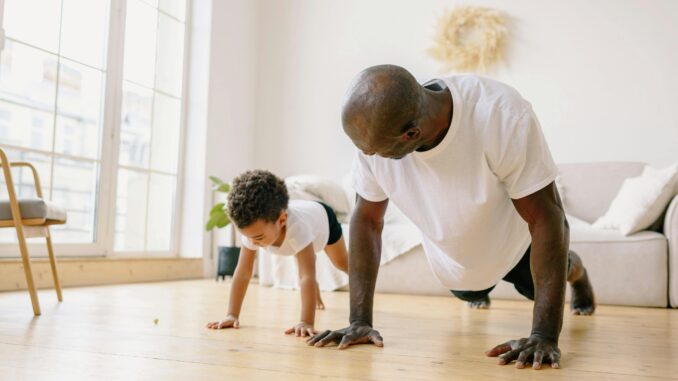
Photo by Ksenia Chernaya: https://www.pexels.com/photo/a-father-and-son-planking-7302890/
